
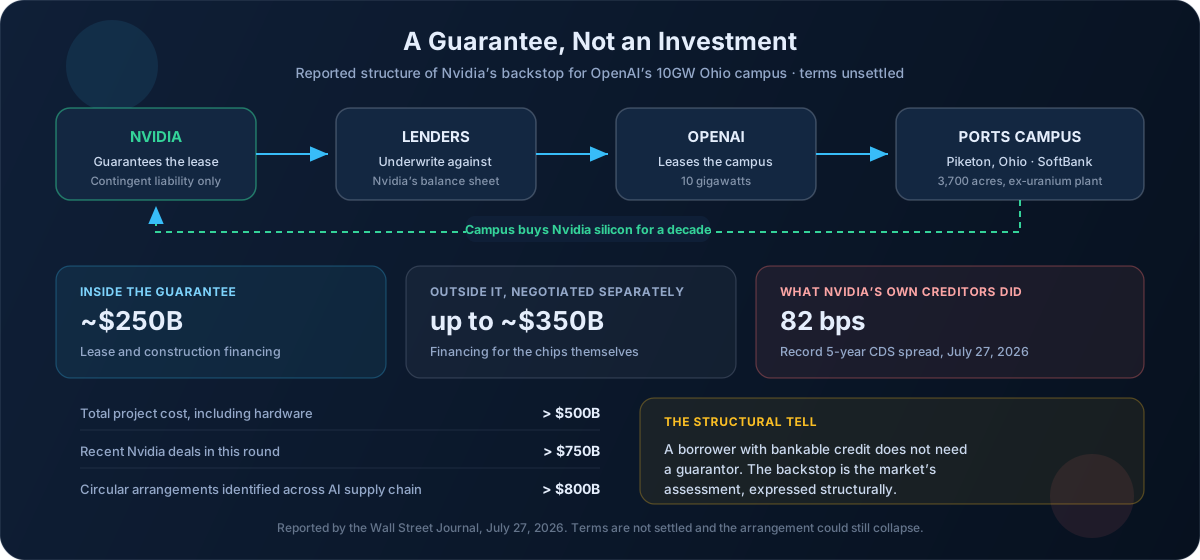
The Wall Street Journal reported on July 27 that Nvidia is in talks to guarantee roughly $250 billion of financing so OpenAI can lease a 10-gigawatt data center campus in southern Ohio. Terms are not settled and the arrangement could still fall apart. If it closes as described, it would be the largest vendor-financing commitment in the history of the technology industry.
The number is arresting on its own, and the week since has produced a more useful signal than the headline did. What matters is the structure, because a guarantee is not an investment, and the difference explains why the deal exists at all.
What the Money Actually Does
Nvidia would not be handing OpenAI $250 billion. It would be standing behind OpenAI’s obligations on the lease and the construction financing, which means lenders get Nvidia’s balance sheet as collateral rather than OpenAI’s. Nvidia books a contingent liability. Cash moves only if OpenAI fails to pay.
The chips are outside that scope. In a separate negotiation reported alongside it, Nvidia is discussing financing for OpenAI’s purchase of the silicon that would fill the campus, a figure that could reach $350 billion. Total project cost including hardware is expected to exceed $500 billion.
The site is the PORTS Technology Campus in Piketon, Pike County, on roughly 3,700 acres of federal land at the former Portsmouth Gaseous Diffusion Plant, a Cold War uranium enrichment facility that stopped operating in 2001. SoftBank’s energy subsidiary is developing it. The land already has the grid interconnection and the industrial zoning that make ten gigawatts conceivable, which is why a decommissioned enrichment plant is worth this much to anyone.
A Guarantee Is What You Get When Lenders Say No
OpenAI does not need a guarantor if lenders will finance a 10GW lease against OpenAI’s own credit. That the backstop is being negotiated at all is the market’s assessment, expressed structurally: at this size and duration, OpenAI’s revenue is not yet bankable on its own terms.
That is not a slight against OpenAI’s business, which is growing fast. It is a statement about tenor. A data center lease of this scale runs for a decade or more, and lenders underwriting a ten-year obligation want to see ten years of predictable cash flow behind it. OpenAI has enormous revenue and enormous losses, in a market where the price of frontier inference has fallen sharply and repeatedly. Anthropic cut Opus pricing in half six weeks after launching a premium tier. Chinese labs are serving near-frontier agent workloads at $0.14 per million input tokens. Those are exactly the conditions that make a credit committee ask who else is on the paper.
So Nvidia signs. And the reason Nvidia is willing to sign is that the campus, if built, consumes Nvidia silicon for a decade.
Nvidia’s Own Credit Market Disagreed
The circular-financing objection is well worn by now. Nvidia takes positions in or extends credit to companies that then buy Nvidia hardware; analyses published this year have identified more than $800 billion of such arrangements across the AI supply chain. The Ohio backstop is part of a broader round of Nvidia deals worth over $750 billion, including an SK Group partnership the two companies describe as more than $500 billion of mutual business. Michael Burry has been among the louder critics.
Jensen Huang rejects the framing, and his argument has real content. Nvidia’s contributions are a small fraction of what its partners raise elsewhere, he has said, calling the circular characterization ridiculous. On the specific mechanics he has a point: a guarantee that never gets drawn costs nothing, and if the campus operates and pays its lease, Nvidia will have converted an unused contingent liability into a decade of silicon demand. Vendor financing is ordinary in capital equipment. Boeing and Airbus have done versions of it for decades.
The more interesting response came from Nvidia’s own creditors rather than from commentators. On July 27, Nvidia’s five-year credit default swap spread rose to a record 82 basis points, the largest single-day intraday move since the contract began trading actively in November 2025. A CDS spread is the price of insuring against a company’s default, and it is set by people with money at risk rather than by people with opinions. That market looked at a company with one of the strongest balance sheets in the world, taking on a contingent obligation, and repriced the risk of holding its debt.
Eighty-two basis points is not distress, and Nvidia remains an exceptionally sound credit. The direction is what matters, because the entity absorbing the risk here is not the one whose credit was in question, and its own lenders repriced it within hours.
What Compounds the Exposure
The concentration is what makes this different from Boeing financing an airline. An aircraft has a resale market, a second and third operator, and a residual value that survives the first customer’s bankruptcy. A purpose-built 10GW AI campus is worth what the next AI tenant will pay for it, and the set of organizations that can absorb ten gigawatts is very short.
Underwriting the lease also means Nvidia is exposed to problems that have nothing to do with OpenAI’s business. Ten gigawatts is roughly the continuous output of ten nuclear reactors, and grid interconnection is now a live political question in a way it was not two years ago. New York imposed a data center moratorium this month. Water and power siting fights are becoming routine, and the cooling load at this scale is not a footnote. Construction delay, an interconnection queue, or a state legislature can impair a lease that OpenAI is otherwise willing and able to pay.
None of that makes the deal unsound. It makes it a bet that AI compute demand a decade out justifies the largest vendor guarantee ever written, placed by the company that sells the compute. That bet may well pay. It is simply worth naming as a bet rather than as infrastructure.
If You’re Buying Compute, Not Financing It
The practical read for anyone running workloads is narrower than the headline suggests, and mostly reassuring in the near term. Capacity of this kind takes years to energize, and if it lands it puts downward pressure on inference prices well into the 2030s. Nothing about your model selection this quarter changes because of a term sheet in Ohio.
The medium-term read is about concentration risk in your vendors. The same capex pressure IBM warned about is now being managed with financial engineering rather than with cash, which works until demand growth slows. If your architecture assumes one frontier provider forever, this is another argument for keeping a second one wired up and tested, not because OpenAI is fragile but because the whole structure is now leveraged to a single demand forecast.
It is worth remembering that none of this is signed. Reported talks collapse routinely, and the WSJ story is careful to say terms are unsettled, so the most likely near-term outcome is a quieter deal at a smaller number. The detail to track either way is Nvidia’s CDS spread, which will say whether the credit market treats this structure as sound once it has had time to read the documents rather than the headline. That number has no incentive to flatter anyone, which currently makes it the most informative thing anybody has published about this deal.
Sources
- Nvidia in talks to guarantee $250 billion for mega Ohio data center, WSJ reports — Reuters via Yahoo Finance
- Nvidia reignites “circular” AI concerns as it weighs OpenAI financing guarantee — Axios
- Nvidia’s $750 Billion in Deals Reignite Circular AI Fears — Bloomberg
- Nvidia’s $750bn AI deals push its credit default swaps to record — The Next Web
- Nvidia considers $250bn backstop for OpenAI’s planned 10GW Ohio data center — Data Center Dynamics
- NVIDIA is about to spend $750 billion on AI. Critics are calling it a bubble — NPR