
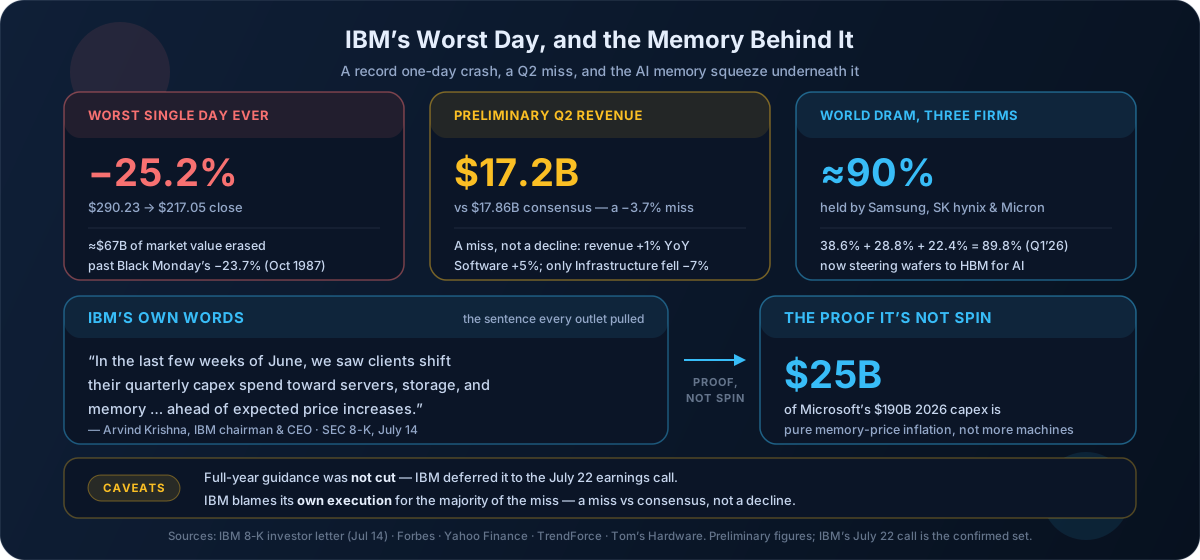
IBM filed an unscheduled 8-K on July 14, eight days ahead of its own scheduled earnings call, to tell investors that preliminary second-quarter revenue had landed at $17.2 billion against a $17.86 billion consensus. The stock closed down 25.2% at $217.05 from a $290.23 prior close — the worst single day in IBM’s history, past the 23.7% it dropped on Black Monday in October 1987 — and roughly $67 billion of market value went with it. The reason that letter matters to a business nowhere near IBM’s size is one sentence in it about where IBM’s customers put their money instead.
What IBM Actually Said
The sentence, verbatim from Arvind Krishna’s letter: “In the last few weeks of June, we saw clients shift their quarterly capex spend toward servers, storage, and memory purchases to secure supply-constrained infrastructure ahead of expected price increases.” And a few lines later: “we did not anticipate the magnitude of the capex reprioritization.”
That is the quote everyone pulled, and it is the interesting part of the document. It is not what IBM says caused the quarter. The same letter says: “this quarter we faltered. We did not adapt and move quickly enough, and numerous large deals failed to close on the timelines we expected, driving the majority of our shortfall.” IBM assigns the majority of its miss to its own execution, and separately names cybersecurity distraction, the z17 mainframe cycle wrapping up, and Transaction Processing weakness. “AI capex killed IBM’s quarter” is a better headline than the primary source supports.
Two corrections the secondary coverage fumbled. IBM did not cut full-year guidance — several outlets reported that it did; the letter defers full-year expectations to the July 22 call. And this was a miss against expectations, not a decline: revenue grew 1%, Software grew 5%, operating EPS grew 5% to $2.93, and only Infrastructure fell, at -7%. Distributed Infrastructure — the part of IBM that sells servers and storage — grew 37% on roughly $500 million of backlog, its best in reported history. The same capex reprioritization that wrecked IBM’s quarter produced its fastest-growing line, and most tellings just don’t mention that.
The Sentence Still Matters
Strip out every IBM-specific problem and one fact survives: enterprise buyers pulled hardware purchases forward, in the closing weeks of a quarter, because they expect hardware to cost more later. That reverses the assumption almost every IT budget of the last few decades rests on — that waiting is free, that the same box bought in nine months is a cheaper box. They are not being paranoid. The scarce input in this industry stopped being the model a while ago and is now the physical machine, which is why the same week produced a lawsuit between Apple and OpenAI over hardware trade secrets rather than over models.
Why Memory Is the Choke Point
Three companies took 89.8% of DRAM revenue in the first quarter of 2026 — Samsung at 38.6%, SK hynix at 28.8%, Micron at 22.4% — so roughly 90% of the world’s DRAM sits with a trio facing the same incentive. That incentive is HBM, the stacked memory feeding AI accelerators, which carries a better margin than the DDR5 in your file server. TrendForce puts HBM at about 22% of total DRAM wafer input among the top three suppliers by the end of 2026, and every wafer that becomes HBM is a wafer that does not become server RAM. The memory bandwidth wall that governs LLM inference is why accelerators want that capacity badly enough to outbid you for it.
On price, TrendForce expects server DRAM contract prices up 13-18% quarter-over-quarter in Q3 2026 — a range, and one whose direction deserves care, since TrendForce’s actual argument is that the increases are moderating rather than accelerating. The channel numbers are rougher: trade outlets put DDR5 ECC RDIMM at roughly double its early-2025 price, a 256GB DDR5 ECC server refresh that ran $800-1,200 in early 2025 at nearer $2,000-3,500 today, and GPU servers up 30-50%. Those come from vendor blogs rather than market data — read them as direction, not a price sheet, though the direction is well corroborated by Samsung’s own shortage warnings and IDC’s.
The Number That Should Worry You
Microsoft guided calendar-2026 capex to $190 billion against a $152 billion analyst consensus, and CFO Amy Hood told investors that $25 billion of that is memory and component price inflation — not more machines, the same machines costing more. The backdrop: Alphabet, Amazon, Microsoft and Meta together guided to roughly $695-725 billion of 2026 capex against about $410 billion in 2025, a 70-77% increase, at their April 29 earnings. Oracle is not in that basket, whatever the five-company versions of the number circulating say.
The tempting conclusion is that if the most powerful buyer on earth can’t negotiate its way out of memory inflation, nobody can. The evidence supports something less flattering and more useful to you. TrendForce reports that several US-based cloud providers hold multi-year agreements restricting suppliers from raising prices on them, and that increases are concentrating among customers lacking such agreements. Microsoft did negotiate its way partly out — and still booked $25 billion of inflation. You have no such contract. You buy at spot, which is exactly where the industry has decided the increases should land.
What To Do With This
If you have a server or workstation refresh scheduled inside the next 12-18 months, the price curve argues for pulling it forward — which is what IBM’s clients did in late June, and why IBM’s Distributed Infrastructure line grew 37%. Be clear-eyed about the trade: you are buying into a spike on the bet that the spike outlasts your delay. If DRAM rolls over in 2027, you paid the top. That is a judgment call, not arbitrage, and any version of this advice that doesn’t say so is selling you something.
For new workloads, rent rather than own while DRAM is rationed. Opex absorbs a supply shock better than a capital purchase does, and you are not the one bidding against hyperscalers for wafer allocation. The catch is that your provider is eating the same curve and will pass it through — Microsoft’s $25 billion is the preview of that bill — so price the workload against what inference actually costs rather than against this year’s rate card.
Do not plan to wait it out. New HBM capacity takes two to three years to stand up, putting meaningful relief no earlier than late 2027, and nothing on the demand side is bending: TSMC reported $40.20 billion of revenue at a 67.7% gross margin on July 16 and guided Q3 to $44.6-45.8 billion.
Then use the software side of it. IBM just told the market that large deals are slipping, and software and consulting names sold off in sympathy on a day none of them reported anything. Vendors carrying that fear into quarter-end are more negotiable than they were six months ago, which makes the next few weeks a good window to reopen SaaS renewals — the same dynamic that ran through last February’s software selloff. One caution before you cite the carnage in a negotiation: the percentages that circulated that afternoon were premarket snapshots, not closes. Accenture, the most-quoted casualty, finished down 2.86%. The selloff was real; most of the numbers pinned to it were not, which is becoming a pattern.
One Quarter, One Company
Whether this is a durable reallocation from software budgets into infrastructure or a one-quarter pull-forward that unwinds by October is unresolved, and one company’s bad quarter — a company that blames its own execution for the majority of it — is thin evidence for a structural claim. IBM’s July 22 call is the next real data point.
The memory math does not depend on IBM being right about anything, though. Three firms hold about 90% of DRAM, they have moved capacity toward the product with the better margin, and the new capacity takes years that have not started running. IBM’s clients front-running the price increases in the last weeks of June were not panicking. They were reading the same supply curve you can read, and they moved first.
Key Details
| Item | Detail |
|---|---|
| Event | Unscheduled IBM investor letter (SEC 8-K, Ex-99.1) |
| Date | July 14, 2026, eight days before the scheduled call |
| Preliminary Q2 revenue | $17.2B (+1%) vs $17.86B consensus (-3.7%) |
| Operating EPS | $2.93 (+5%) vs $3.01 consensus |
| Segments | Software +5%, Consulting +1% cc, Infrastructure -7% |
| Distributed Infrastructure | +37%, ~$500M backlog — best in reported history |
| Share move | -25.2%, $290.23 to $217.05; ~$67B erased |
| Prior worst day | -23.7%, October 19, 1987 |
| Full-year guidance | Not cut — deferred to the July 22 call |
| DRAM concentration | Samsung 38.6% + SK hynix 28.8% + Micron 22.4% = 89.8% of Q1 2026 revenue |
| Server DRAM, Q3 2026 | +13-18% QoQ (TrendForce), with increases moderating |
| Microsoft 2026 capex | $190B guided; $25B of it memory/component inflation |
Sources
- IBM investor letter, July 14, 2026 — SEC 8-K Exhibit 99.1
- IBM shares crashed 25% in worst day ever, here’s why — Forbes
- IBM stock plummets more than 25% on Q2 earnings warning — Yahoo Finance
- IBM plunges on Q2 warning as enterprise spending shifts — The Motley Fool
- IBM warning hits software stocks — Yahoo Finance
- Server DRAM contract price outlook, 3Q26 — TrendForce
- HBM share of DRAM wafer input through 2026 — TrendForce
- Samsung leads DRAM market share at 38.6%, SK hynix trails — TechTimes
- Microsoft attributed $25 billion of its record AI budget to memory chip costs — Tom’s Hardware
- Microsoft lifts 2026 capex by $25B to cover price rises — The Register
- Alphabet, Amazon, Microsoft and Meta plan more than $700 billion on capex this year — Sherwood News
- Samsung warns of memory shortages driving industry-wide price surge in 2026 — Network World
- Global memory shortage crisis: market analysis — IDC
- Q2 2026 quarterly results — TSMC investor relations