
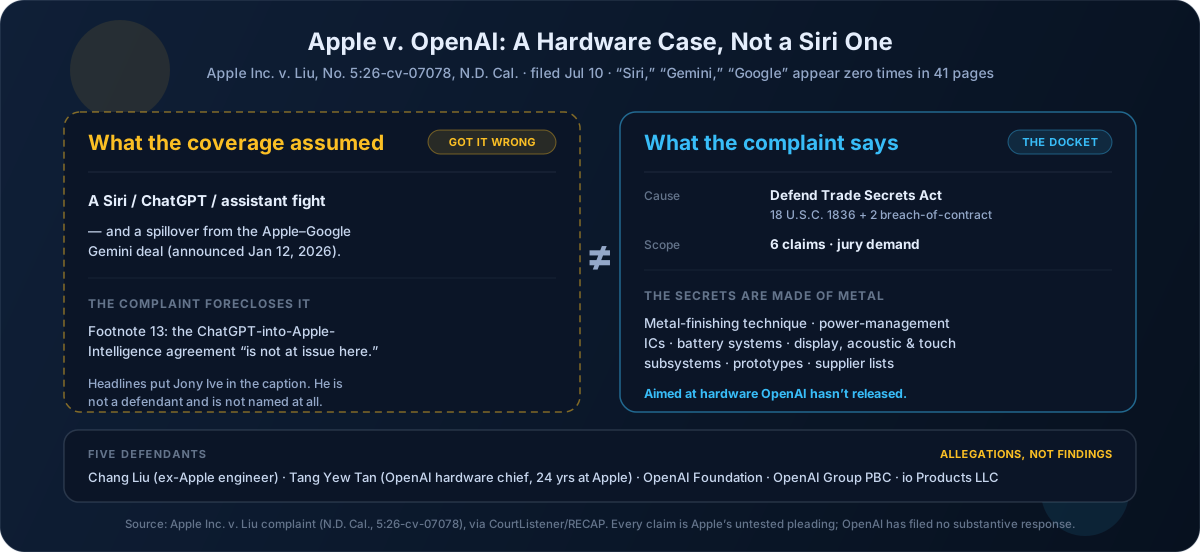
Apple sued OpenAI in federal court on Friday, July 10, and most of the first weekend’s coverage got the subject of the case wrong. Apple Inc. v. Liu, No. 5:26-cv-07078, sits in the Northern District of California before Magistrate Judge Virginia K. DeMarchi, and the 41-page complaint has nothing to do with Siri, nothing to do with ChatGPT, and nothing to do with anybody’s models. It is a Defend Trade Secrets Act case about physical objects — metal finishing, batteries, logic boards, supplier lists — aimed at hardware OpenAI has not yet released. Across all 41 pages, the words “Siri,” “Gemini,” and “Google” appear zero times.
The correction is the story, and it carries a caveat that holds for everything below: every factual claim here is Apple’s untested pleading. OpenAI has filed no substantive response, no evidence has been weighed, nothing has been ruled on.
What the Docket Says, Before Anyone Paraphrases It
Filed Friday, July 10 — not July 11, as much of the aggregation had it. Five defendants: Chang Liu, a former Apple senior system electrical engineer; Tang Yew Tan, OpenAI’s Chief Hardware Officer; OpenAI Foundation; OpenAI Group PBC; and io Products, LLC, the design startup OpenAI bought for approximately $6.5 billion in 2025. Jony Ive is not a defendant and is not named anywhere in the complaint, which identifies Tan as an io co-founder instead; the headlines putting Ive in the caption are wrong.
The complaint pleads exactly six claims — four under the DTSA against Liu, Tan, OpenAI, and io, plus two for breach of Apple’s Intellectual Property Agreement, the confidentiality contract each engineer signed on hiring. Several search summaries this week add California state trade-secret claims; there are none, and the absence matters, because California voids non-competes, leaving trade secret law as Apple’s only lever against employee mobility.
The Secrets Are Made of Metal
Apple’s list of what it says walked out the door is where the case stops resembling an AI story. The complaint describes a proprietary metal-finishing technique, “power management integrated circuits, battery systems, and display, acoustic, and touch subsystems,” design artifacts, prototypes, and supplier identities. It alleges that Tan — at ¶8, twenty-four years at Apple, most recently Vice President of Product Design for iPhone and Apple Watch — told candidates to bring “actual parts” to interviews for what the filing calls “show and tell” sessions. The parts he allegedly asked for: “Batteries,” “SIP” (systems-in-package), “mlb” (main logic boards), “shields.”
Footnote 13 forecloses the assistant angle outright. The ChatGPT-into-Apple-Intelligence agreement, it says, “is not at issue here,” and the alleged misappropriation has “no connection to that agreement.”
The Gemini Deal Is Six Months Old and Unrelated
The deal readers keep connecting this to is Apple’s Google arrangement, and the calendar refuses to cooperate. Google and Apple announced their multi-year Gemini collaboration on January 12, 2026 — six months before this filing, five months before the rebuilt Siri appeared at WWDC on June 8. The ~$1 billion-a-year figure everyone quotes traces to a Bloomberg report from November 2025 saying Apple was nearing such a deal; the joint statement names no dollar amount and neither company has confirmed one.
Musk and Altman did spend Saturday, July 11 calling each other names on X — one day after the filing, not two, though CNBC published on the 12th and the internet took the publication date for the event date, the same manufactured-timeline reflex that produced the Siri framing. SpaceXAI had shipped Grok 4.5 days earlier and OpenAI GPT-5.6; none of it touches the merits.
Apple’s Account, Which Is an Account
The allegations are vivid, which is why the hedging has to be load-bearing. Apple claims that Liu, an eight-year engineer who left on January 22, 2026, kept a work computer and exploited what the complaint calls “a rare, previously unknown authentication bug” to reach Apple’s internal network for weeks after starting at OpenAI, pulling down dozens of confidential files, one compilation of which ran over a thousand pages. It attributes a message to him: “LOL, I found out I can access the [network storage], so funny.” Its central line, at ¶13: “at every level, from members of its Technical Staff to its Chief Hardware Officer, and in coordination with business partners, OpenAI has been stealing Apple’s trade secrets and confidential information.”
OpenAI’s communications director, Drew Pusateri, said on filing day that “we have no interest in other companies’ trade secrets”; on July 14 the company sharpened it to “we’re not aware of any evidence that this complaint has merit.” Apple says it first wrote to OpenAI in February 2026 (¶14), five months before suing.
One figure will get quoted without its qualifier: the complaint says over four hundred former Apple employees now work at OpenAI. That is Apple’s count, and hiring at that scale from a competitor is legal in California — the alleged wrong is the document-taking, not the recruiting. Note the failure mode, though. Apple allegedly lost its data to a laptop nobody collected and credentials that still worked, a poor advertisement for any offboarding process funded less well than Apple’s.
What This Looks Like From a Distance
Strip out the personalities and the filing is a document about what OpenAI has become. A company whose competitive surface was, until recently, benchmark tables and token prices — the terrain where the open-weight labs are still fighting — is now being sued over anodizing and supplier lists, because it bought a hardware design shop, hired the man who ran iPhone product design for two decades, and started building a device. The moment a lab crosses into physical goods its hard problems stop being architectural and turn industrial: who finishes the enclosure, who supplies the cells, what the yield is, what it costs at volume. Those are problems Apple has spent twenty years solving and is now asserting ownership of in court — the same pressures surfacing on the balance-sheet side of the industry. Software was the cheap part.
What Is Actually on the Calendar
Nothing has been decided, and the docket says so: 23 entries as of July 16, four filed that day, all appearances, pro hac vice motions, scheduling, and summonses. The Initial Case Management Conference is set for October 13 in San Jose, and the first document that will tell anyone anything is OpenAI’s answer or its motion to dismiss, neither of which exists. One docket detail outweighs the whole weekend of commentary: Quinn Emanuel has appeared for OpenAI Foundation, OpenAI Group PBC, Tan, and io Products, while Chang Liu — the named first defendant, the man the case is captioned after — has no counsel listed at all. Four defendants share a firm and the fifth has nobody, which is either administrative lag or the first sign their interests diverge. The metal finishing gets tested in discovery, and discovery is years from telling anyone who was right.
Key Details
| Spec | Detail |
|---|---|
| Case | Apple Inc. v. Liu, No. 5:26-cv-07078 |
| Court | N.D. Cal. (San Jose), Magistrate Judge Virginia K. DeMarchi |
| Filed | July 10, 2026 (41-page complaint) |
| Statute | Defend Trade Secrets Act of 2016 (Nature of Suit 880) |
| Defendants | Chang Liu; Tang Yew Tan; OpenAI Foundation; OpenAI Group PBC; io Products, LLC |
| Claims | Six — four DTSA, two breach of Apple’s Intellectual Property Agreement |
| Secrets alleged | Metal finishing, power management ICs, battery systems, display/acoustic/touch subsystems, CAD, prototypes, supplier data |
| Relief sought | Injunction, damages, exemplary damages, attorneys’ fees, return of materials, jury trial |
| Counsel | Weil, Gotshal & Manges (Apple); Quinn Emanuel (OpenAI, Tan, io); none on docket for Liu |
| OpenAI response | No answer or motion to dismiss filed; “not aware of any evidence that this complaint has merit” (July 14) |
| Next date | Initial Case Management Conference, October 13, 2026 (statement due October 6) |
Sources
- Apple Inc. v. Liu — CourtListener docket
- Apple’s complaint, 41 pages — CourtListener/RECAP (PDF)
- Apple sues OpenAI over alleged trade secret theft — TechCrunch
- The wildest allegations in Apple’s trade secrets lawsuit against OpenAI — TechCrunch
- Apple says former employee exploited rare bug to download confidential files — TechCrunch
- OpenAI pushes back on Apple trade secret lawsuit — TechCrunch
- OpenAI responds to Apple’s trade secret theft lawsuit — 9to5Mac
- Apple sues OpenAI for trade secret theft — 9to5Mac
- Joint statement from Google and Apple, January 12, 2026 — blog.google
- Apple nears deal to pay Google $1B annually to power new Siri, report says — TechCrunch
- Elon Musk and Sam Altman spar over the Apple lawsuit — CNBC