
Bloomberg reported on July 16 that Gemini 3.5 Pro — the flagship Google promised for June and still has not delivered — is months behind schedule, and that what is holding it up is the model’s coding ability. Alphabet closed down 4.44% at $354.46 against a prior close of $370.92, erasing roughly $200 billion in market value in a day. Business Insider had reported the slip before Bloomberg did, so this was not a lone scoop landing out of nowhere.
That is the news, and it is the least interesting thing here. The interesting thing is that the July 17 launch date which spent this week propagating across a dozen tech sites had already been retracted — by the account that originated it — on July 13, three days before Bloomberg published. Several of the write-ups carrying “Targets July 17” went up the same day the source killed the date. The rumor outlived its own source by three days, and nobody in the chain noticed, because nobody in the chain was reading the source.
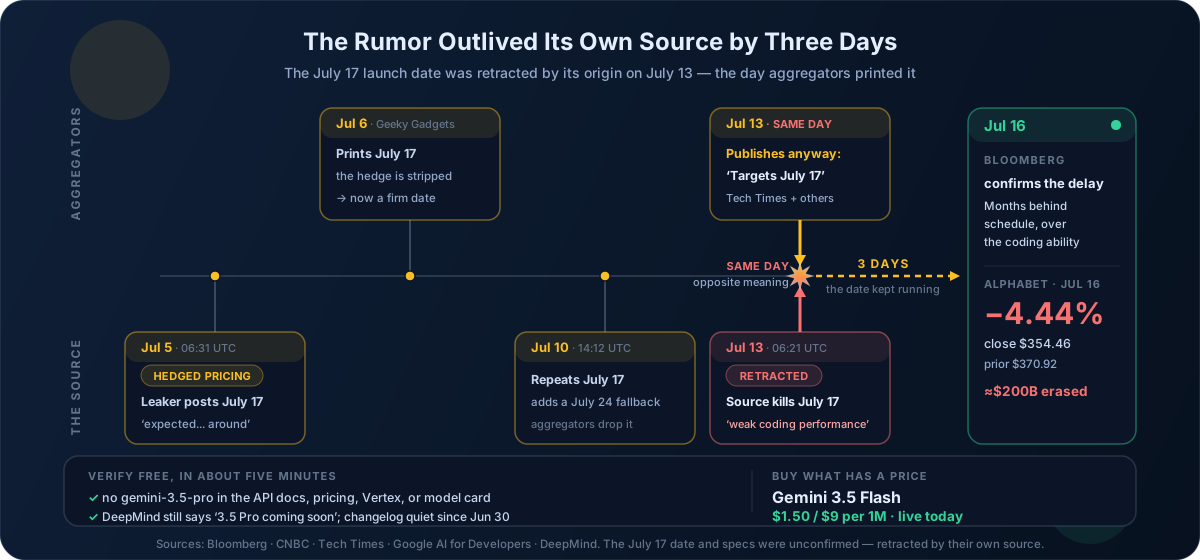
The Date Was Dead Before the Headlines Ran
The chain is short and every link in it is checkable. On July 5 at 06:31 UTC, an X account with a real track record on Gemini pricing — it called Gemini 3.5 Flash at $1.50/$9 on the day of I/O, which is exactly the official price today — posted a cluster of 3.5 Pro claims: a July 17 launch, a 2-million-token context window, Deep Think, and what it explicitly labelled “expected” API pricing of “around” $12-15 per million input tokens and $36-45 per million output. Geeky Gadgets picked it up on July 6. On July 10 at 14:12 UTC the same account repeated July 17 and added that July 24 was the fallback. Then on July 13 at 06:21 UTC it retracted the whole thing: 3.5 Pro was delayed to the end of this month or next, and the latest internal checkpoints were “still undercooked,” with “weak coding performance and frequent knowledge cutoff hallucinations.”
Also on July 13, Tech Times published a piece headlined “Gemini 3.5 Pro Targets July 17 After Full Rebuild — Every Spec Remains Unconfirmed,” and Geeky Gadgets ran its third 3.5 Pro leak story in eight days. Those three Geeky Gadgets pieces credit three different YouTube channels as their media source — Universe of AI, then WorldofAI for the July 17 and 2M-context one, then TheAIGRID — which is a supply chain where the sourcing rotates freely and the conclusion never does.
Watch what the aggregation layer did to the source material at each hop. It stripped the hedge, so “expected pricing, around $12-15” hardened into a price. It dropped the fallback date, because “July 17, or possibly July 24” is not a headline. It ignored the retraction completely. The failure here is not the leaker’s: he hedged the pricing in the original post, published a fallback, corrected himself within eight days, and got the underlying reason right before any newspaper did. He did the thing the outlets quoting him did not do, which was keep checking.
Two Sources, Opposite Directions, Same Answer
Here is the part that deserves more attention than the stock move. The retraction on July 13 blamed weak coding performance in the internal checkpoints. Bloomberg’s reporting on July 16, sourced to people familiar with the matter, put the delay down specifically to the model’s coding ability, and described a training-data update aimed at coding late last month that produced disappointing results. An anonymous leak account and a wire service with a newsroom arrived at the same root cause from opposite ends of the information chain, three days apart.
That is real corroboration, and it means the leak ecosystem was not wrong. It had the right answer on July 13. The aggregation layer sitting on top of it printed the stale headline anyway — including, in the Tech Times case, an outlet whose own headline conceded that every spec was unconfirmed while still leading with the dead date. Being unsure in the subheading does not undo committing in the headline.
How to Check This Yourself, Free, in About Five Minutes
The reason to be confident 3.5 Pro is not shipping tomorrow is not that Bloomberg says so. It is that Google’s own properties say so, publicly, at no cost, to anyone who looks. There is no gemini-3.5-pro model ID in the Gemini API docs, which today list gemini-3.1-pro-preview as the current Pro model, still in preview, alongside gemini-3.5-flash as stable. There is no entry on the pricing page. There is no Vertex AI listing in any state, not even a private preview. There is no model card and no launch post on Google’s blog. DeepMind’s own Gemini page says “3.5 Pro coming soon” twice while listing 3.1 Pro as the model you can actually use.
The best single check is the one nobody seems to run: the Gemini API changelog is a dated release log, and the most recent model release on it is Gemini Omni Flash’s public preview on June 30. A model shipping tomorrow does not leave that log untouched for two weeks.
The same five minutes disposes of the specs. The 2-million-token context figure appears in no Google document — not the I/O keynote post, not the Gemini 3.5 announcement, nowhere. Deep Think is not a 3.5 Pro novelty at all; Gemini 3.1 Deep Think is listed as available right now. And the pricing rumor is contradicted by a competing rumor putting 3.5 Pro at $0.25/$2, roughly fifty times apart — when two rumors disagree by that margin, neither of them knows. This is the same discipline that applies to reading a lab’s own launch chart or any benchmark claim a vendor makes about itself: the primary document is free, and it is definitive.
For the record, what Sundar Pichai actually said at I/O on May 19 was “We’re also excited for Gemini 3.5 Pro,” and that it was coming the following month. It did not. A Google spokesperson’s statement this week — rendered in the third person, so likely a paraphrase rather than an on-record quote — said the company is testing 3.5 Pro, an upgraded Flash model, and other models with partners. Note that 3.5 Pro is one item in a list there, and that the upgraded Flash model is arguably the more useful disclosure. On the revised schedule itself, the spokesperson declined to comment.
Buy What Exists
If you were holding a build, a migration, or a vendor decision for “3.5 Pro next week,” stop, and do not re-schedule around whatever date replaces July 17. Google is still testing the model with partners and Bloomberg says it is months out. Plan on what has a price.
That is Gemini 3.5 Flash at $1.50 per million input and $9.00 per million output, and Gemini 3.1 Pro Preview at $2.00/$12.00 for prompts up to 200k tokens, rising to $4.00/$18.00 above that — a tier worth checking against your actual prompt sizes before you model the cost, and the kind of threshold that quietly dominates a production bill. None of this is a Gemini obituary. Flash is genuinely strong; Google shipped it at I/O posting Pro-tier benchmark numbers, and the pattern of a Flash model out-coding the Pro above it is one Google has run before. Gemini 3.1 Pro remains a benchmark leader on the strength of results you can look up.
The sharpest line for a buyer is buried in the Bloomberg reporting, and it is not about the schedule. DeepMind staff reportedly raised concerns that Google lacks a clear commercial product for businesses building AI coding tools — the category where Anthropic and OpenAI have pulled ahead. A delayed model is a quarter. A missing product in the fastest-crowding segment in the market is a strategy problem, and it is the one that should actually inform a multi-year integration bet.
The Part Worth Keeping
Google being late with a frontier model is unremarkable. Training runs miss, coding is the hardest thing to fix late, and a lab that shipped a weak Pro model to protect a date would have earned a worse week than this one. Treat the delay as ordinary.
What is not ordinary is that a public, retracted, timestamped correction sat in the open for three days while an entire content layer kept selling the version it had already superseded — and that the aggregators have since fused this delay with a separate June story about DeepMind departures, merging two distinct stock drops into a single tidy narrative. That layer will have a new date by the time you read this. It costs nothing to open the changelog instead.
Key Details
| Spec | Detail |
|---|---|
| Model | Gemini 3.5 Pro |
| Status | Announced May 19, 2026 — not shipped |
| Promised | June 2026 (“coming next month” at I/O) |
| API model ID | None — absent from API docs, pricing, and Vertex AI |
| Rumored date | July 17, 2026 — retracted by the originating account on July 13 |
| Reported delay | Months behind schedule, over coding ability (Bloomberg, July 16) |
| Latest API changelog release | Gemini Omni Flash public preview, June 30 |
| Alphabet close, Jul 16 | $354.46, down 4.44% (~$200B erased) |
| Available Pro model | Gemini 3.1 Pro Preview — $2/$12 per 1M (≤200k), $4/$18 (>200k) |
| Available Flash model | Gemini 3.5 Flash — $1.50/$9 per 1M |
| Unconfirmed specs | 2M context; $12-15/$36-45 pricing — in no Google document |
Sources
- Google Gemini launch delayed as tech falls short of internal goals — Bloomberg
- Google Gemini launch delayed, Bloomberg News reports — U.S. News (syndicated wire)
- Alphabet stock falls on report of Gemini AI model delays — Investing.com
- Alphabet stock and the Gemini 3.5 Pro delay — CNBC
- Gemini API models list — Google AI for Developers
- Gemini API pricing — Google AI for Developers
- Gemini API changelog — Google AI for Developers
- Gemini models overview (“3.5 Pro coming soon”) — Google DeepMind
- Vertex AI generative AI model list — Google Cloud
- Sundar Pichai at I/O 2026 — Google Blog
- Gemini 3.5 announcement — Google Blog
- Gemini 3.5 Pro targets July 17 after full rebuild — every spec remains unconfirmed — Tech Times