
DeepSeek took its V4-Flash API out of preview on July 31 at $0.14 per million input tokens and $0.28 per million output, with cache hits at $0.0028. The pricing is identical to the April preview, and so are the architecture and the parameter count, still the 284 billion total and 13 billion active we covered at launch.
The benchmark scores are not unchanged. On the nine agent evaluations DeepSeek publishes, the official V4-Flash now beats V4-Pro-Preview, the company’s own 1.6-trillion-parameter flagship, on every single one. Same model, same size, same price, retrained.
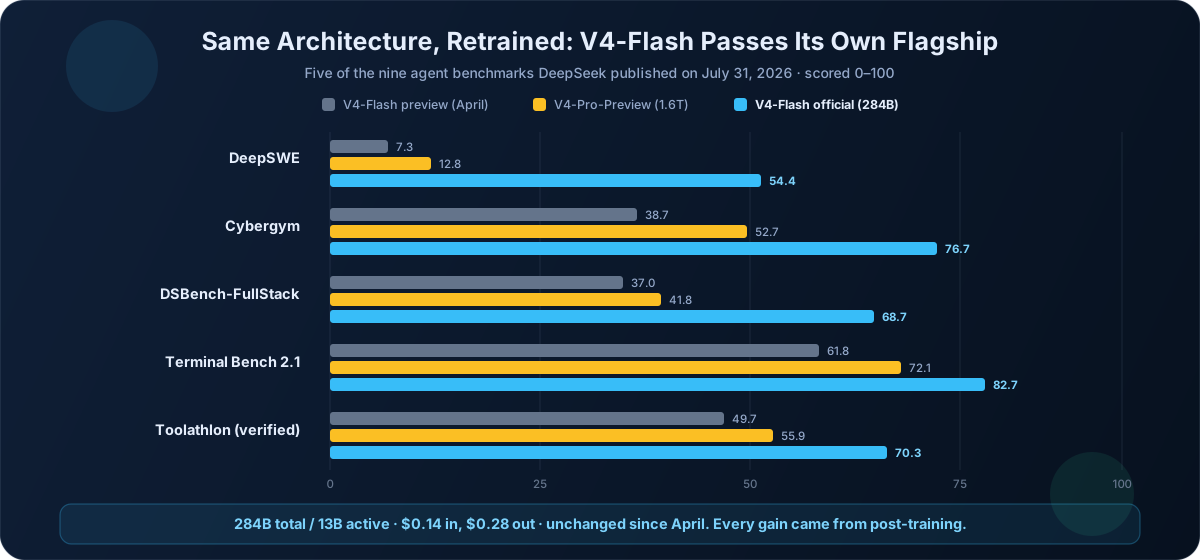
The Table
| Benchmark | V4-Flash official | V4-Flash preview | V4-Pro-Preview |
|---|---|---|---|
| Terminal Bench 2.1 | 82.7 | 61.8 | 72.1 |
| NL2Repo | 54.2 | 39.4 | 38.5 |
| Cybergym | 76.7 | 38.7 | 52.7 |
| DeepSWE | 54.4 | 7.3 | 12.8 |
| Toolathlon (verified) | 70.3 | 49.7 | 55.9 |
| Agents’ Last Exam | 25.2 | 15.8 | 16.5 |
| AutomationBench (public) | 25.1 | 10.8 | 12.8 |
| DSBench-FullStack | 68.7 | 37.0 | 41.8 |
| DSBench-Hard | 59.6 | 25.8 | 31.1 |
The DeepSWE row is the one worth stopping on. A jump from 7.3 to 54.4 is not a tuning improvement, it is the difference between a model that essentially cannot resolve real software issues and one that resolves more than half of them. Cybergym roughly doubles and Terminal Bench moves 21 points, and nothing in the network changed to produce any of it.
The caveat is that these are DeepSeek’s own published evaluations of DeepSeek’s own models, and the two comparison columns are both preview checkpoints rather than finished products. V4-Pro-Preview was never claimed to be a finished model. Beating an unfinished flagship is a softer result than beating a shipped one, and DeepSeek chose that comparison itself. Artificial Analysis independently scores the official Flash around 50 on its Intelligence Index, third among open-weight models it tracks, which is a real external number but a coarser one than a nine-benchmark sweep.
Post-Training Is Where Agent Capability Now Lives
DeepSeek states the gains came entirely from extended post-training. The architecture, the compressed sparse attention scheme, and the active parameter count are all identical to what shipped in April.
For anyone deciding what to build on, that is the actual news, and it cuts against the reflex the industry spent 2025 reinforcing. Parameter count has been the headline number on every Chinese frontier release this month: Kimi K3 at 2.8 trillion, Qwen3.8-Max at 2.4 trillion. Here a 284B model with 13B active per token overtakes a 1.6T sibling on the exact workloads people are buying agents for, because someone spent three months on trajectory data and reinforcement learning instead of on a bigger run.
That does not mean scale stopped mattering. It means the marginal return on agent tasks has, at least for this generation, shifted toward the training that teaches a model to use tools, recover from failed steps, and stay coherent across a long horizon. Those are learned behaviors, not emergent properties of width. A 1.6T model with weak agent post-training loses to a 284B model with strong agent post-training, and DeepSeek just published the receipts for that on its own lineup.
The release also adds native Responses API support and Codex compatibility. Both are unglamorous and both matter more than they sound: they mean an existing agent harness can point at DeepSeek without a rewrite. For teams already calling deepseek-v4-flash, the migration is nothing at all, since the endpoint, key, and model name are the same and the retrained weights are simply behind them now.
What the Cost Comparison Looks Like
Artificial Analysis reports the cost of running its full Intelligence Index evaluation on each model. On that measure V4-Flash comes in around $0.03 per task, against $0.86 for Kimi K3, $1.86 for GPT-5.6 Sol, and $3.15 for Claude Fable 5. That last ratio is roughly 105x.
Two things keep that number from being the whole story. Fable 5 scores materially higher, so the comparison is capability-adjusted only if your work sits in the band where both models succeed. And V4-Flash is verbose, generating about 210 million output tokens across the index against a 100 million median for comparable models, which means its real bill runs higher than the headline per-token rate implies. Cheap tokens and many tokens partially cancel.
Even discounting for both, the gap is wide enough to change build decisions. Lian Jye Su at Omdia framed the Chinese position as serving workflows that don’t need the industry’s best model, and V4-Flash is the sharpest version of that argument yet: it is not the frontier, and for classification, extraction, routing, bulk code review, and most internal agent work, it does not need to be. The question worth asking about any given workload is no longer whether the cheap model is good enough in general. It is whether you have measured it on your tasks.
V4-Pro Still Hasn’t Shipped
The flagship remains in preview. DeepSeek says an official V4-Pro is coming “as soon as possible” and has attached no date to that, having already slipped past a mid-July target for this Flash release. A company that just demonstrated it can extract this much from post-training on the small model has an obvious reason to hold the large one back until the same treatment is applied, and an equally obvious reason not to announce a date it might miss twice.
Read the omission for what it is rather than as a failure. DeepSeek shipped the model that most people should be using and deferred the one that generates headlines. Given that the deferred model just lost to the shipped one across nine benchmarks, that ordering is defensible.
For teams evaluating this: run it against your own agent traces before believing any of the numbers above, including the independent ones. The gap between a benchmark suite and a production workload is where most model migrations go wrong, and a model that improved this dramatically through post-training is precisely the kind that can have sharp edges the published evaluations don’t reach.
Sources
- DeepSeek-V4-Flash Goes Official: Agent Benchmarks Beat V4-Pro-Preview — DeepSeek
- DeepSeek Releases Official V4-Flash Model as China’s AI Race Intensifies — Caixin Global
- DeepSeek V4 Flash 0731 model page — Artificial Analysis
- DeepSeek V4-Flash Beats Its Own Pro Model — Flowtivity
- Alibaba unveils Qwen3.8-Max as DeepSeek’s new model undercuts Anthropic — Tech Startups