
Moonshot AI published the Kimi K3 weights on July 27, hitting the date it committed to when the model launched eleven days earlier. The Hugging Face repository holds 118 files totaling roughly 1.56 terabytes. The license is real, the model card is real, and the parameter count Moonshot declined to publish at launch is now in the open.
That settles the objection we raised in July, which was that a promised open-weight release is not an open-weight release and labs miss those dates routinely. Moonshot hit its date and deserves the credit for it. The more interesting problem surfaced right afterward, which is that anyone can download these weights and almost nobody can run them.
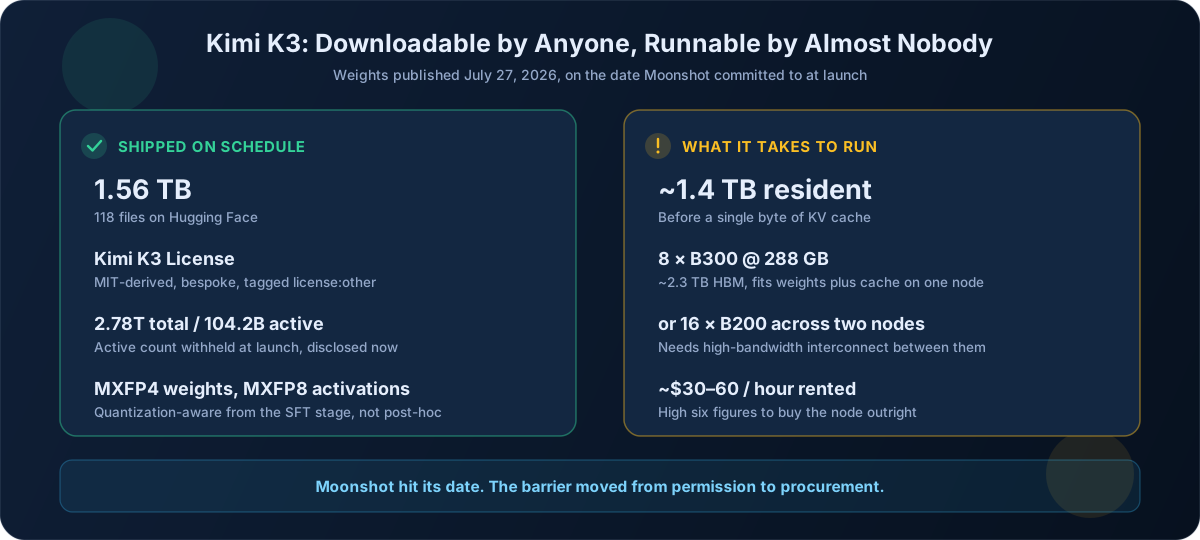
What Landed
K3 is 2.78 trillion total parameters activating 104.2 billion per token. That second number matters more than the first, and its absence at launch was the most conspicuous gap in Moonshot’s announcement: sparse models are sold on the ratio between total and active parameters, and K2.6 had shipped with its 32B-of-1T figure disclosed without hesitation. Now the comparison is possible. K3 activates roughly 3.3x what its predecessor did per token, which is a real capability investment and also the reason the serving cost is what it is.
The weights ship natively quantized. Expert weights are MXFP4 with MXFP8 activations, trained quantization-aware from the supervised fine-tuning stage rather than compressed after the fact. That is why the download is 1.56TB instead of the roughly 5.6TB the same model would occupy in BF16. Moonshot built the four-bit format into training rather than treating it as a deployment afterthought, which is the correct engineering call and saves anyone hosting it a 4x memory bill.
On Artificial Analysis, K3 scores 57 on the Intelligence Index, which makes it the strongest open-weight model available by that measure. The frontier ranking has moved around it since launch as Claude Opus 5 landed, but the open-weight claim is the one Moonshot was making and it holds.
The License Is Permissive Until You Get Large
K3 ships under a bespoke “Kimi K3 License,” tagged license:other on Hugging Face rather than MIT or Apache 2.0. It is MIT-derived and permissive in the ways most users care about: download, run, modify, fine-tune, distribute, and deploy commercially at no license cost.
Two thresholds sit on top of that. Operating a model-as-a-service business with group revenue above $20 million over any consecutive twelve months requires a separate agreement with Moonshot before commercial use. And any product exceeding either 100 million monthly active users or $20 million in monthly revenue has to prominently display “Kimi K3” in its interface. Purely internal use is exempt, as is access through Moonshot’s own products and certified partners.
Neither condition touches a normal engineering team. Both are aimed squarely at hyperscalers reselling the model as an API, which is the same commercial instinct Meta encoded in the Llama license and Zhipu in GLM-5.2. Calling it “open source” is a stretch under the OSI definition. Calling it open weights is accurate, and for the overwhelming majority of people who would actually download 1.56TB, the distinction is academic.
The Real Gate Is Memory
Here is where the release stops being about licensing. At MXFP4, K3 needs roughly 1.4 terabytes resident before you allocate a single byte of KV cache, and KV cache at million-token context is not a rounding error.
A single-node deployment means something like 8× B300 at 288GB each, about 2.3TB of HBM, which fits the weights plus cache with room to work. The alternative is 16× B200 split across two nodes with high-bandwidth interconnect between them. Moonshot’s own deployment guidance points at supernode configurations of 64 accelerators or more for production serving, which is a throughput recommendation rather than a hard floor, but it tells you what the lab expects a real deployment to look like.
Price that honestly. An 8×B300 node is capital expenditure in the high six figures, or roughly $30 to $60 per hour rented, depending on provider and commitment. The breakeven math against Moonshot’s hosted API at $3.00 input and $15.00 output per million tokens is a straightforward calculation, and for most workloads it does not come out in favor of self-hosting. You divide the node’s hourly cost by your sustained output tokens per second and compare. Unless you are saturating that hardware around the clock, the API is cheaper, and you have to measure your actual sustained throughput rather than the vendor’s peak figure to know where you land.
The population that actually benefits from these weights being public is therefore narrower than the phrase suggests. It comes down to labs that want to study a frontier-scale architecture, inference providers with existing fleets and the utilization to fill them, and organizations whose regulatory position makes sending data to a Chinese API endpoint a non-starter regardless of cost. That last group has the most to gain, and it is also the group least likely to trip the $20M service threshold in the license.
What It Signals
The gap between “open weights” and “deployable” has been widening for two years, and K3 is the clearest illustration of it so far. When Llama 3 8B shipped, open weights meant a developer with a decent GPU could run the thing that week. At 2.78 trillion parameters, open weights means the artifact is public and the barrier moved from permission to procurement.
That is not a criticism of Moonshot, which did exactly what it said it would do on exactly the day it said it would. It is a note on what the word has come to mean. Openness at this scale is a transparency guarantee and a hedge against vendor lock-in. It is not access in the sense the term carried when the open-model movement started, and anyone budgeting on the assumption that “open” implies “cheap to run” should check the memory math before the license.
For most teams this release changes very little in practice. Use the hosted endpoint, keep the weights in mind as leverage and as insurance against a pricing change or a service withdrawal, and revisit self-hosting when you have either a compliance mandate or enough sustained utilization to justify the node. The weights being public is what makes that insurance real, and that is worth something even if you never download them.
Sources
- Kimi K3 model card and weights — Moonshot AI on Hugging Face
- Kimi K3: KDA, MXFP4, and the self-host breakeven math — RunPod
- Kimi K3 Open Weights Shipped: What the Licence Says — Digital Applied
- Kimi K3 model page — Artificial Analysis