
Lawrence Berkeley National Laboratory’s 2024 report to Congress estimates that U.S. data centers directly consumed about 17 billion gallons of water in 2023, roughly triple their 2014 total, and projects hyperscale facilities alone could reach 16 to 33 billion gallons a year by 2028. Oracle, meanwhile, says each building at the Stargate campus in Abilene, Texas (eight buildings, 1.2 gigawatts, about four million square feet) will use roughly 50,000 gallons a year for cooling, less than what an average American household runs through in the same period. Both numbers hold up.
The distance between them exists because “data center water use” is not one quantity. It depends on how heat leaves the chips, how the building dumps that heat outdoors, the climate the building sits in, what generates its electricity, and which of at least three different meanings of “use” the speaker picked. The defensible claim in mid-2026 is narrower than either side of the argument wants: onsite cooling water has become a design choice, the newest flagship AI builds are mostly choosing near-zero, and the installed fleet, the data centers actually serving your workloads today, remains a mixed and often thirsty population that the new designs will take years to displace.
The Numbers Disagree Because They Measure Different Things
Start with the two words that do the most damage when swapped: withdrawal and consumption. Withdrawal is water taken from a source; much of it may return to the same watershed after use. Consumption is the share that doesn’t come back, because it left as vapor. A cooling tower consumes; a once-through system mostly withdraws. U.S. thermoelectric power plants withdraw about 133 billion gallons a day but consume only a few percent of it. Quoting a withdrawal figure as if it were consumption inflates the impact; the reverse understates it.
The industry’s standard metric inherits the same ambiguity. Water usage effectiveness, or WUE, is liters of water per kilowatt-hour of IT energy, but the companies reporting it don’t meter the same thing. Microsoft’s fleet average of 0.27 L/kWh for fiscal 2025 is a consumption figure. Amazon’s 0.12 L/kWh for 2025 is a withdrawal figure, as the company itself states. The EU’s data center reporting regulation calculates WUE from total water input crossing the facility boundary, a third variant. Neither company hides its methodology; nearly everyone quoting the two numbers side by side ignores it.
The national average carries the same trap. Divide Berkeley Lab’s 66 billion liters by the 176 TWh U.S. data centers drew in 2023 and you get about 0.375 liters per facility kilowatt-hour, a useful ratio but not a WUE, since the denominator is total electricity rather than IT load. And facility-level reality scatters wildly around any average: a 2025 peer-reviewed review from Berkeley Lab researchers (Lei et al., Resources, Conservation and Recycling) found workload-level water use varies by more than 10,000-fold. In their ranking of what drives that variation, server efficiency comes first, then the water intensity of the electrical grid, then server utilization; the cooling system type everyone argues about is fourth.
So when two water numbers disagree, the useful first move is to ask which boundary each one drew.
A Data Center Gets Rid of Heat Twice
Every cooling architecture answers two separate questions. First: how does heat get out of the servers? Air blown across heatsinks, liquid pumped through cold plates bolted to the chips, or full immersion. Second: how does the building discharge that heat outdoors? This is the step that determines the water bill, and it has four broad options: mechanical chillers, evaporative cooling towers, dry coolers, and pumped-refrigerant systems. That taxonomy comes from NVIDIA’s own technical material. Even the vendor pushing liquid cooling hardest is explicit that liquid cooling alone doesn’t settle the water question.
A cooling tower consumes water because evaporation is the mechanism — the tower cools by turning water into vapor on purpose, then bleeds off more (“blowdown”) to keep dissolved minerals from concentrating in what remains. It is energy-efficient and water-hungry. A dry cooler is the opposite trade: a building-sized radiator that keeps every drop in the loop but pays for it in fan power and in needing outdoor air cool enough to accept the heat.
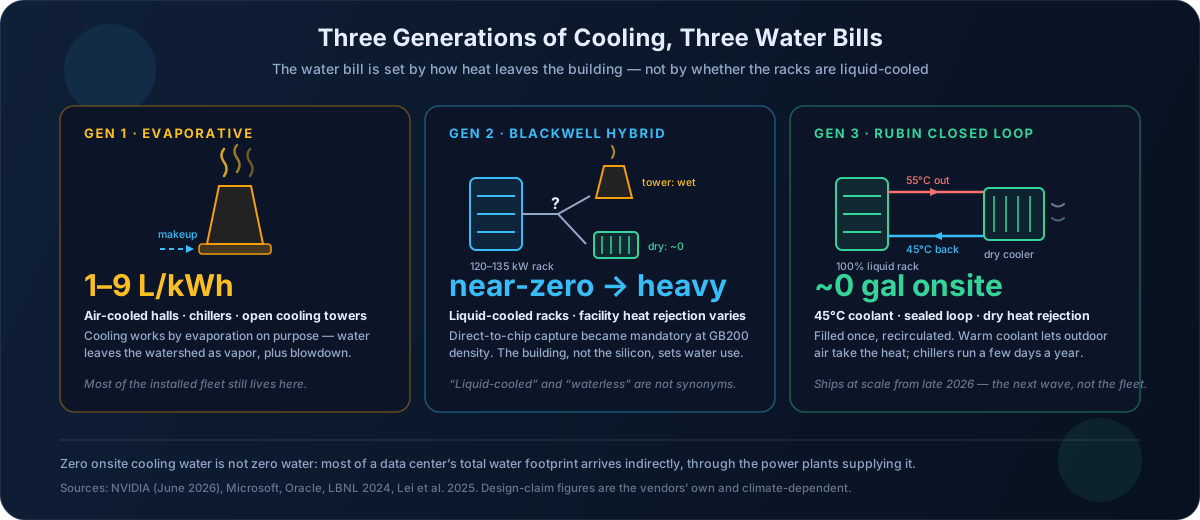
This is why “liquid-cooled” and “waterless” are not synonyms. Liquid cooling describes how heat leaves the equipment. A direct-to-chip loop can hand its heat to a water-cooled chiller plant that evaporates millions of gallons through a tower, liquid-cooled and water-intensive at once. And an air-cooled hall can be nearly waterless: Google’s new Wilbarger County, Texas facility and its Meitner campus in Gray County use advanced air cooling precisely to avoid cooling towers, with water use limited to kitchens and restrooms. When an operator says “closed loop,” the verification question is always the same: follow the heat to where it leaves the property, and ask whether anything evaporates there.
Three Generations, Three Water Bills
Generation one is the installed base: conventional halls, air-cooled servers at rack densities that still average under 10 kW, chilled-water plants, and in many locations evaporative towers running year-round. In Uptime Institute’s 2025 cooling survey, roughly a fifth of operators report using direct liquid cooling anywhere in their footprint, while three-quarters still run perimeter air cooling. Recent syntheses put direct cooling-water intensity for wet-cooled facilities at roughly 1 to 9 liters per kWh depending on climate and technology. This generation is what the alarming water statistics describe, and the statistics are not wrong about it.
Generation two is the Blackwell era. A GB200 NVL72 rack draws about 120 kW, and NVIDIA cites AI halls exceeding 135 kW per rack. At those densities, moving enough cold air through the chassis stops being practical, so direct liquid cooling became mandatory with Blackwell-class silicon. But the facility side stayed unsettled: some Blackwell deployments hand heat to dry coolers, others to towers, many to hybrids. NVIDIA claims the GB200 NVL72 delivers “300x more water efficiency” than air-cooled architecture. Treat that as marketing arithmetic until proven otherwise. It sits in a slide next to “40x revenue potential,” it is normalized per unit of work rather than counted at a meter, and NVIDIA hasn’t published the methodology. The version that survives the caveats is smaller and still important: Blackwell made liquid capture universal at the high end while leaving the water-deciding step to whoever builds the building.
Generation three is Rubin, and it closes the loop. On June 22, NVIDIA announced that its Vera Rubin platform accepts coolant entering at 45°C (113°F, warmer than a hot tub) and leaving around 55°C, with 100% of the rack liquid-cooled: every chip and every networking component, sealed front panels, no fans. The point of hot coolant is what it does to the second step. Fluid returning at 55°C is warm enough for outdoor dry coolers to shed its heat in most climates most of the year, so mechanical chillers become backup equipment (needed, NVIDIA says, “just a few days a year” in warmer regions) and cooling towers can disappear entirely. Against a traditional evaporative baseline NVIDIA puts at about 2.6 million gallons per megawatt per year, its dry-cooled reference design claims effectively zero, plus more than $4 million in annual cooling energy and water savings for a 50 MW facility. These are vendor figures, and they are climate-dependent; NVIDIA’s own material concedes a site in the Scottish Highlands and a site in Phoenix face different realities. Mass production is slated for fall 2026, which means Rubin describes the next construction wave, not the fleet you’re using today.
The physics is not new; NREL has run a chiller-less, warm-water-cooled supercomputing facility for over a decade. Rubin’s contribution is packaging: the same approach productized at 120-kW-and-up rack density, with a manufacturing ecosystem and hyperscaler purchase orders behind it.
What the 2026 Build Wave Actually Uses
The current crop of flagship builds bears the generational story out, each from a slightly different angle.
Microsoft’s first Fairwater AI datacenter in Mount Pleasant, Wisconsin, went fully operational in late June. More than 90% of its capacity runs on a closed liquid loop that was filled once during construction and recirculates continuously; the remainder cools on outside air and switches to water only on the hottest days. Nor is Fairwater a special case: Microsoft announced in December 2024 that every new datacenter design from August 2024 forward consumes zero water for cooling, avoiding what it estimates at more than 125 million liters per year per facility. Its fleet WUE, 2.3 L/kWh in the early 2000s, now sits at 0.27.
Crusoe and Oracle’s Abilene campus, the flagship Stargate site, runs direct-to-chip liquid cooling on a zero-water-evaporation closed loop. Oracle’s description is the most concrete in the industry: the loop is filled once by tanker truck, then sealed (no evaporation, no blowdown, no makeup water), leaving about 50,000 gallons per building per year in cooling maintenance. Company-reported, but specific enough to be checkable. Crusoe is replicating the design at a 1.4 GW campus in Childress, Texas.
Meta’s template for its one-gigawatt AI campuses is a closed loop with dry coolers; the $10 billion El Paso site says it will use zero water for cooling the majority of the year. El Paso summers are why “majority” is the operative word there, and the pledge to restore 200% of consumed water rides alongside, which tells you Meta expects consumption to stay nonzero.
Google proves the low-water outcome doesn’t even require liquid: its new Texas campuses reject heat through air alone. AWS is the honest hybrid. Its latest components support liquid and air cooling on the same footprint, it says without increasing water use per megawatt, and much of its fleet runs on outside air for most of the year, evaporating water during the hottest hours. AWS doesn’t market any of this as waterless; it reports a 0.12 L/kWh withdrawal WUE and, for the first time, an absolute figure of about 2.5 billion gallons withdrawn in 2025.
Set these five next to Meta’s $145B capex year and the flagship tier has plainly converged: near-zero onsite cooling water is becoming the default spec, reached from three different directions: sealed liquid loops, warm-coolant dry rejection, and plain air cooling. Water objections now carry permitting risk, and the builders are engineering the objection away before it’s raised. None of this means “data centers no longer use water.” The fleet is not the flagship tier, and a five-year-old colocation hall with open towers drinks exactly what it drank in 2021.
Where Data Centers Rank Against Everything Else
National context first, with the accounting boundary labeled, because the favorite trick on both sides of this argument is comparing a withdrawal to a consumption and letting the reader assume they match.
| Category | Volume | Metric type |
|---|---|---|
| U.S. thermoelectric power | 133 billion gal/day | Withdrawal (USGS, 2015) |
| U.S. irrigation | 118 billion gal/day | Withdrawal (USGS, 2015) |
| U.S. public water supply | 39 billion gal/day | Withdrawal (USGS, 2015) |
| U.S. residential outdoor watering | ~8 billion gal/day | End use (EPA WaterSense) |
| U.S. data centers, direct | ~47 million gal/day | Consumption (Berkeley Lab, 2023) |
Annualized, the entire U.S. data center industry’s direct consumption is under 1% of what American lawns take, and equivalent to the at-home use of roughly 570,000 people at EPA’s 82-gallons-per-person benchmark. At national scale there is no story here, which is exactly why the national scale is the wrong frame. Water problems are watershed problems, and data centers cluster. Virginia’s legislative audit agency JLARC found the state’s data centers used about 2.1 billion gallons in 2023, up 86% since 2019, and concluded the total was “currently sustainable,” with just over a third supplied by reclaimed water. But inside that statewide comfort, Loudoun County utilities reported roughly 899 million gallons of potable water going to data centers in 2023, up about 250% in a few years. The 2021 study that mapped this properly (Siddik, Shehabi and Marston) found a fifth of servers’ direct water footprint sits in moderately-to-highly water-stressed watersheds, and nearly half of U.S. servers draw at least some power from plants in water-stressed regions. Peak cooling demand also lands in summer, exactly when municipal systems and drought restrictions are tightest. A nationally trivial industry can still be the largest new straw in a specific basin.
For facility-scale intuition, translate WUE into an annual bill per megawatt of IT load running around the clock:
| Water intensity | Gallons per MW-year | Where you’d see it |
|---|---|---|
| ~0 after one-time fill | ~0 | Sealed closed loop + dry rejection (Abilene, Fairwater, El Paso designs) |
| 0.12 L/kWh | ~280,000 | Amazon’s 2025 fleet average (withdrawal basis) |
| 0.27 L/kWh | ~620,000 | Microsoft’s FY2025 fleet average (consumption basis) |
| 1 L/kWh | ~2.3 million | Efficient evaporative cooling; NVIDIA’s “traditional” baseline is ~2.6M |
| 9 L/kWh | ~21 million | High end of published range: hot climate, always-wet heat rejection |
The spread between the first and last rows is the debate, and both ends of it are operating in Texas right now.
One comparison genre deserves retirement: the virtual-water matchup, where a data center’s cooling meter gets compared against the full lifecycle water of a hamburger or a pair of jeans, rainfall on feed crops included. Those comparisons are structurally rigged in the data center’s favor, because the beef number includes the supply chain and the data center number doesn’t. A fair version would put semiconductor fabrication, construction, and electricity on the data center side too, and few of the circulating comparisons do.
What “Zero Water” Leaves Out
Even a perfectly sealed loop comes with fine print.
The fill is real water, delivered once (tanker trucks in Oracle’s case), plus small annual maintenance top-ups, which is trivial next to a cooling tower but not literally zero.
Every qualifier in those announcements clusters on the hottest days: Fairwater’s air-cooled fraction switches to water on peak days, Meta says “majority of the year,” and NVIDIA says chillers run “a few days a year” in warm climates. Those are exactly the days when the local watershed is most stressed. A design that is waterless in April and thirsty during a July drought emergency should be evaluated on July.
Electricity is the bigger omission. Siddik’s 2021 mapping found most of the U.S. data center water footprint arrives indirectly, through power generation, and a 2026 commentary in AGU Advances estimates that on average roughly two-thirds of data centers’ total water use ties back to electricity, against about a quarter for cooling. This cuts in an uncomfortable direction for dry cooling: fans and backup chillers draw more power than evaporative systems, so a “waterless” facility on a thermoelectric-heavy grid can consume more water — at someone else’s cooling tower — than a wet-cooled facility running on wind and solar. Grid mix can flip the ranking. That’s also why the co-location pattern matters: Google’s Texas campuses and Meta’s El Paso build are being paired with dedicated new generation, which determines their indirect water intensity far more than anything inside the halls.
And the supply chain sits behind everything: the chips come from fabs that are themselves major industrial water users; TSMC’s Arizona expansion is landing in a desert metro for reasons unrelated to hydrology. The accurate label for the new designs is “near-zero onsite cooling water,” not “waterless AI.”
Five Questions to Ask About Any Proposed Data Center
Whether you’re a county board, a rate-payer, or a business deciding where workloads run, the answers that matter fit on one page:
- Is the final heat rejection dry, evaporative, or hybrid? Not “is it liquid-cooled” — where does the heat leave the property, and does anything evaporate there?
- What are projected annual withdrawal and consumption at full build-out? Both numbers, with the boundary stated. A WUE without its methodology is a decoration.
- Potable, reclaimed, or non-potable supply? A third of Virginia’s data center water is reclaimed; Loudoun’s fastest-growing line item is drinking water. Same state, opposite answers.
- What happens on the hottest days and under drought restrictions? Get the trigger conditions and the fallback water source in writing. The annual average is not the failure mode.
- What is the water intensity of the electricity? A dry-cooled campus on a wet grid has not eliminated water use; it has exported it.
The Argument Is About Yesterday’s Fleet
Most viral claims about AI’s thirst extrapolate from generation-one facilities, which are accurately measured and increasingly unrepresentative of what’s being built. Most industry reassurance describes generation-three designs that ship at scale starting late 2026. Both camps are aiming at the other’s strawman, and both will keep finding ammunition, because the fleet and the flagship will coexist for years.
What’s actually worth watching is narrower: whether the sealed-loop builds hold their numbers under sustained heat, at full utilization, once the press releases stop; whether disclosure standardizes, now that the EU mandates WUE reporting with a defined methodology, JLARC has recommended Virginia localities get explicit authority to demand water estimates, and New York’s moratorium fight has shown how quickly one state’s template travels; and whether any of this reaches the installed base, because that is where the gallons are.
The engineering case for wet cooling was always that water is cheaper than electricity, and for decades it was. Permits and public hearings have now made water expensive in ways the utility bill never captured, and the vendors redesigned around the new price within about two product cycles. That redesign is genuine, and the data center running your workloads this afternoon was almost certainly built before it.
Sources
- 2024 United States Data Center Energy Usage Report — Lawrence Berkeley National Laboratory
- The water use of data center workloads: a review and assessment of key determinants — Lei et al., Resources, Conservation and Recycling (2025)
- The environmental footprint of data centers in the United States — Siddik, Shehabi and Marston, Environmental Research Letters (2021)
- Data centers water footprint: the need for more transparency — AGU Advances (2026)
- Moving toward 100% liquid-cooled AI infrastructure — NVIDIA (June 2026)
- How liquid cooling supports water efficiency in AI factories — NVIDIA
- NVIDIA announces liquid cooling system that runs “hotter than a hot tub” — Tom’s Hardware
- Microsoft completes construction on first datacenter facility in Mount Pleasant, Wisconsin — Microsoft (June 23, 2026)
- Inside Microsoft’s two-decade push to cut water intensity while scaling for growth — Microsoft (June 24, 2026)
- Sustainable by design: next-generation datacenters consume zero water for cooling — Microsoft (December 2024)
- Abilene data centers — Oracle
- Closed-loop cooling in Oracle AI data centers — Oracle (February 2026)
- Crusoe expands AI data center campus in Abilene to 1.2 gigawatts — Crusoe
- Crusoe to develop 1.4GW data center campus in Childress, Texas — Data Center Dynamics
- Breaking ground on our new AI-optimized data center in El Paso — Meta (October 2025)
- Water — Meta Data Centers
- Expanding our Texas presence with a new data center in Wilbarger County — Google
- AWS announces new data center components to support AI innovation — Amazon (December 2024)
- Amazon’s data centers are 7x more water-efficient than the industry average — Amazon (2026)
- 2025 cooling systems survey — Uptime Institute
- Data Centers in Virginia — Virginia Joint Legislative Audit and Review Commission (December 2024)
- Estimated use of water in the United States in 2015 — USGS Circular 1441
- Statistics and facts — EPA WaterSense
- NREL’s Energy Systems Integration Facility — U.S. DOE Better Buildings