
Thinking Machines Lab released Inkling on July 15 — its first model, trained from scratch: a 975-billion-parameter mixture of experts with 41 billion active per token, natively multimodal, Apache 2.0, and sitting on Hugging Face right now as 108 safetensors shards totaling roughly 1.9TB, ungated, with no terms-acceptance wall in front of them. A day later Moonshot announced Kimi K3 at 2.8 trillion parameters — nearly three times the size, with weights promised for July 27.
The smaller model is the one that shipped, and the difference between a release you can verify and a release you can read about is worth more than the 1.8 trillion parameters between them.
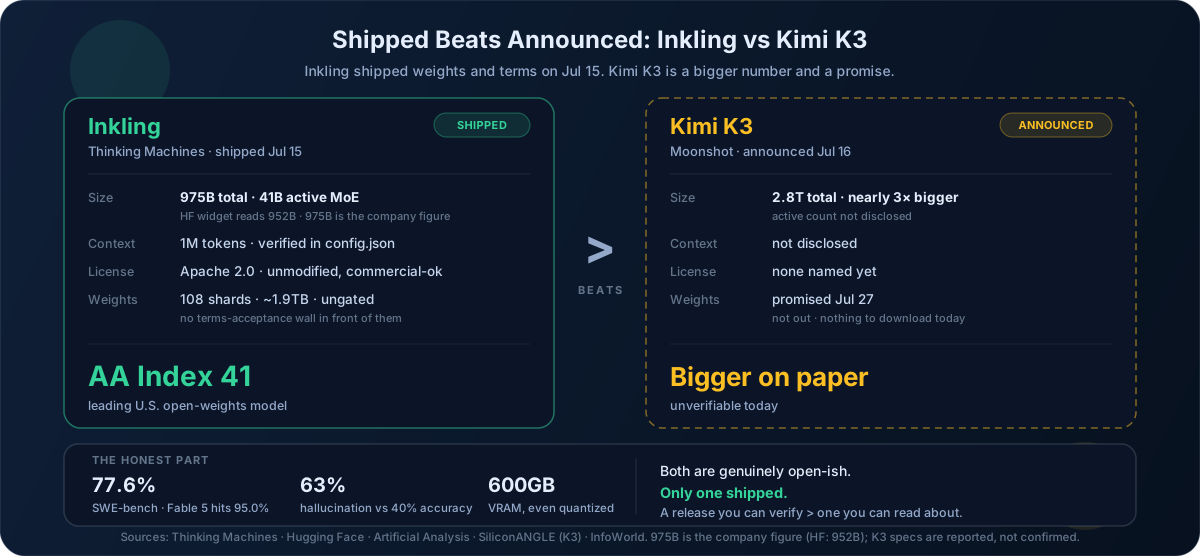
Shipped Is a Claim You Can Check
Every Inkling spec in that first paragraph resolves to a file. max_position_embeddings in config.json reads 1,048,576, which is where the million-token context window comes from, and it sits in the same file as the 66 layers and 256 routed experts a launch post would normally ask you to take on faith. Hugging Face’s API reports the repo as ungated, so you can read the specs and then download the weights.
One figure resists that: Hugging Face’s widget shows 952B parameters where the model card says 975B, and roughly 17B of the gap goes unexplained. Use 975B as the company’s number, not as something Hugging Face corroborates.
Set that against the practice the field has drifted into: announcement now, artifact whenever. Worth naming the asymmetry in this comparison, though — the Inkling side of it comes from files, the K3 side from secondary reporting, mostly SiliconANGLE, which has the 2.8T figure, the July 27 date, and an active parameter count Moonshot has not disclosed. No license has been announced for K3 either, but that is an absence in the coverage rather than a statement from Moonshot, and it deserves care rather than opportunism: the K2 family shipped under a Modified MIT license, so permissive is the expected default, and the open question is the calendar, not the terms.
The License, Read Precisely
The README’s YAML frontmatter declares license: apache-2.0 and points license_link at the canonical, unmodified text on apache.org: no use-based restriction, no acceptable-use addendum, no user-count threshold of the kind Kimi K2.7 Code’s Modified MIT uses to trigger an attribution requirement, no custom clause anywhere — the same plain Apache 2.0 Google put under Gemma 4 in April. For an agency that wants to fine-tune a model and ship it inside a commercial product, that is the most consequential fact in the release, and most of the coverage buried it under the parameter count.
The asterisk is small and worth printing anyway: there is no LICENSE file at the repo root — LICENSE, LICENSE.txt, LICENSE.md and NOTICE all 404. The terms live in Hugging Face metadata and the model card rather than in the download. That is ordinary practice and suggests nothing untoward, but “declared in the metadata” and “ships with the weights” are different sentences, and the criticism we aimed at Moonshot only counts if we are this exact about the release we like.
The Lab Declines to Oversell
The best line written about Inkling this week is the company’s own: “Inkling is not the strongest overall model available today, open or closed.” Labs do not usually write that about their first model, and the table underneath explains why this one could afford to. Inkling scores 77.6% on SWE-bench Verified against Claude Fable 5’s 95.0%, and 29.7% on Humanity’s Last Exam — text-only, the company’s qualifier — against 53.3%. It clears NVIDIA’s Nemotron 3 line on the open-weights rows. The pitch is customization, not capability.
Artificial Analysis independently scores it 41 on Intelligence Index v4.1, ahead of Nemotron 3 Ultra at 38, Gemma 4 31B at 29 and gpt-oss-120b at 24. Read the scope before repeating the superlative: AA’s wording is “the leading open weights release from a U.S. lab,” qualified three ways at once — US only, open weights only, on AA’s index. Inkling is not the first US open model of this generation; Nemotron and gpt-oss shipped ahead of it and are precisely what it is measured against. Every company benchmark, meanwhile, ran at thinking effort 0.99 — the maximum setting, and both the most flattering and the most expensive place to operate.
The same disclosure habit produced the launch’s most awkward footnote: Inkling’s early post-training bootstrapped supervised fine-tuning on synthetic data generated by open-weight models including Moonshot’s Kimi K2.5, before large-scale reinforcement learning took over. It was one source among several and one stage of many, and the company disclosed it itself, but it does mean the leading US open-weights model got part of its start from a Chinese one.
The Failure Mode Is Confident Wrongness
Artificial Analysis measured Inkling at 40% accuracy against a 63% hallucination rate on its AA-Omniscience eval, an aggregate of +2 — below the leading open-weight models, above the other US ones. That is the independent read, not a vendor caveat you can discount, and the company’s own SimpleQA Verified score of 43.9% points the same way, trailing DeepSeek V4 Pro at 57.0% and Claude Fable 5 at 68.3%.
Do not point this model at factual or customer-facing work without retrieval underneath it and a person in front of it. A model that is wrong confidently is a worse problem than a model that is slow, because the failure is invisible at the moment it happens and expensive by the time anyone notices. If you take one number from this release, take that one rather than the Index score.
Efficiency Is the Real Result
Where Inkling does separate from its peers is on token count: Artificial Analysis clocked it at 25,000 output tokens per Intelligence Index task against DeepSeek v4 Pro max’s 37,000, and the company claims it matches Nemotron 3 Ultra on Terminal Bench 2.1 at roughly a third of the tokens. In an agentic loop, where reasoning bills as output and compounds across turns, that shows up on the invoice rather than in a benchmark table. It is the same reason we treated Kimi K2.7 Code’s 30% thinking-token cut as the credible half of that launch, and the same line item that dominates real production AI bills. The sparse routing that lets 41B of 975B parameters do the work is the other half of that arithmetic.
What “Open Weights” Costs
Open is not the same as reachable. BF16 inference needs roughly 2TB of aggregated VRAM — eight NVIDIA B300s or sixteen H200s — and the official NVFP4 checkpoint still wants 600GB. That is a six-figure hardware bill before the first prompt, at a moment when what AI is doing to hardware prices pushes the wrong way. Pareekh Jain, CEO of Pareekh Consulting, told InfoWorld the obvious thing: “Because Inkling is a massive model with 975 billion total parameters, running the full model still requires significant GPU infrastructure, making closed-model APIs more economical for many organizations.”
The API route has fine print of its own. Tinker, the lab’s fine-tuning platform, serves Inkling at 64K and 256K context, which makes the million-token window an architectural property rather than something the company that built it will sell you. Rates run $1.87 per million prefill tokens and $4.68 per million sampled at 64K, doubling at 256K, with training — the actual product strategy here — billed separately at $5.61 and $11.23 per million. All of it carries an explicitly labeled limited-time 50% discount, so any cost model built on today’s numbers should assume roughly double. And Inkling-Small, the 276B/12B variant with the only plausible reach for a normal business, has neither weights nor a date; the company says it is still testing.
The Bar It Cleared
As a model, Inkling is unremarkable — beaten by the closed frontier on every row of its own table, holding a superlative that stops being true if you strip any one qualifier, and carrying a factuality problem that both independent measurement and its own numbers confirm. What makes it the more interesting release of the week is procedural rather than technical.
Thinking Machines published the announcement, the model card, the config, the weights and the license terms on the same day, then said in its own words that the model isn’t the best one available. Moonshot published a bigger parameter count and a date eleven days out. Both are choices, and only one of them can be checked today. A lab that raised $2 billion at a $12 billion valuation last July, watched a reported $50 billion round stall by January, and had exactly one shipped product to its name had every commercial incentive to oversell this, and didn’t.
That leaves the recommendation somewhere unsatisfying. The model you can download needs a data center, and the model you could afford to run is a sentence in a blog post. For most businesses the move this week is to note which lab shipped weights and terms together, and wait for the 276B.
Key Details
| Spec | Detail |
|---|---|
| Lab | Thinking Machines Lab (founded Feb 2025; chief scientist John Schulman) |
| Model ID | thinkingmachines/Inkling |
| Released | July 15, 2026 |
| Total Parameters | 975B (company figure; Hugging Face’s widget shows 952B) |
| Active Parameters | 41B per token |
| Architecture | 66-layer MoE, 256 routed + 2 shared experts, 6 routed active per token |
| Context | 1,048,576 in config.json; Tinker serves 64K and 256K only |
| Modalities | Text, image, audio in — text out |
| Training | 45T tokens |
| License | Apache 2.0 — declared in metadata; no LICENSE file at repo root |
| Download | 108 safetensors shards, ~1.9TB, ungated |
| Self-Host | 2TB aggregated VRAM (BF16); 600GB (NVFP4) |
| Tinker Pricing (64K) | $1.87/M prefill, $4.68/M sample, $5.61/M train — at a limited-time 50% discount |
| Also Available On | TogetherAI, Fireworks, Modal, Databricks, Baseten |
| Inkling-Small | 276B / 12B active — preview, weights not released |
Sources
- Introducing Inkling — Thinking Machines Lab
- Inkling model card — Thinking Machines Lab
- thinkingmachines/Inkling — Hugging Face
- Inkling config.json — Hugging Face
- Inkling file tree: 108 shards, ungated — Hugging Face
- Thinking Machines has released Inkling, the new leading U.S. open-weights model — Artificial Analysis
- Tinker model pricing — Thinking Machines Lab
- Thinking Machines offers enterprises a US alternative in open-weight AI — InfoWorld
- Thinking Machines amps up its bet against one-size-fits-all AI with its first open model, Inkling — TechCrunch
- China’s Moonshot throws gauntlet with Kimi K3, world’s largest open-weights model — SiliconANGLE
- Inkling — Simon Willison
- What is Inkling, Mira Murati’s Thinking Machines’ first AI model — Fortune