
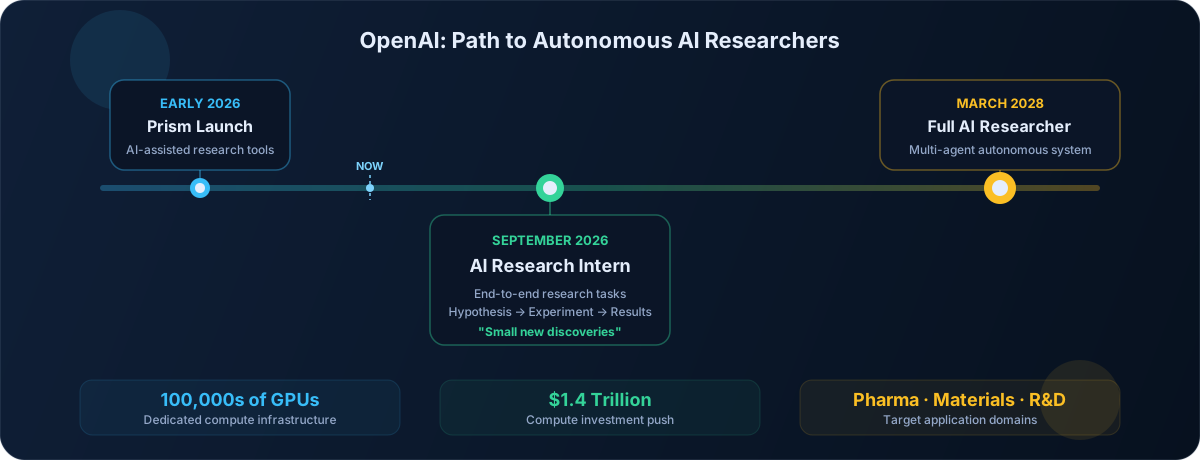
Sam Altman laid out OpenAI’s most concrete research automation timeline yet: an autonomous “AI research intern” by September 2026, capable of independently tackling specific research problems end-to-end. By March 2028, the goal is a fully automated multi-agent research system that can conduct scientific discovery without human intervention. It’s the most ambitious automation target any AI lab has publicly committed to.
The Research Intern
The September 2026 target isn’t a chatbot that answers science questions. OpenAI is building a system that can take ownership of discrete research problems — forming hypotheses, designing experiments, running them, analyzing results, and proposing follow-on work. Think of it as the difference between a tool that helps you write code and one that independently ships features.
The intern model will handle “small work packages” — bounded, well-defined problems where the system can demonstrate end-to-end competence. This mirrors how human research interns operate: given a specific sub-problem, produce results and recommendations without requiring constant supervision.
OpenAI’s VP of Science framed 2026 as a turning point: “I think 2026 will be for AI and science what 2025 was for AI and software engineering.” Given that AI coding tools went from novelty to standard workflow in 2025, the implication is that AI research tools will make a similar leap this year.
Prism: The Foundation
The intern doesn’t exist in isolation. OpenAI launched Prism earlier this year — a collaborative workspace purpose-built for scientific research. Prism gives researchers AI-powered tools for literature review, hypothesis generation, experimental design, and data analysis.
Prism is the proving ground. By embedding AI into active research workflows, OpenAI collects the feedback and failure modes needed to build increasingly autonomous systems. The progression is deliberate: assisted research (Prism today) → semi-autonomous research (the intern) → fully autonomous research (2028 target).
The Scale Required
Altman was blunt about the compute requirements: the research push will run on hundreds of thousands of GPUs and other accelerators. This isn’t a side project that fits on a few clusters. OpenAI views the compute investment as unavoidable if the goal is AI systems that contribute original scientific insights rather than merely summarizing existing knowledge. Advances in extreme compression like Google’s TurboQuant — which achieves 6x memory reduction with zero accuracy loss — could help make this scale more economically viable.
This connects to OpenAI’s broader $1.4 trillion compute push — the largest infrastructure commitment in AI history. The research intern is one of the use cases that justifies that scale. If an AI system can independently produce research that advances a field, the return on compute investment changes dramatically.
What This Means for R&D Automation
The implications extend well beyond academic research:
Pharmaceutical and biotech. Drug discovery involves hypothesis generation, molecular simulation, experimental design, and iterative refinement — exactly the workflow OpenAI is targeting. An AI research intern that can manage a slice of that pipeline could compress timelines that currently span years.
Materials science. Discovering new materials involves exploring vast combinatorial spaces of compositions and structures. Autonomous research systems could run simulation experiments at a pace humans can’t match, identifying promising candidates for physical testing.
Enterprise R&D. Organizations running internal research programs — in finance, manufacturing, energy, or any domain with structured experimental workflows — could deploy similar systems to augment their research teams. The pattern of AI implementation applies here: start with bounded sub-problems, prove value, expand scope.
The Skeptic’s View
September 2026 is six months away, and “autonomous research intern” is a high bar. The challenge isn’t just capability — it’s reliability. A system that produces correct results 80% of the time isn’t useful for research; it’s dangerous, because the incorrect 20% could send teams down expensive dead ends.
OpenAI needs to demonstrate not just that the system can do research, but that researchers can trust its outputs without re-verifying everything manually. If verification takes as long as doing the work, the automation value disappears. This is the same data quality challenge that plagues every AI deployment, amplified by the stakes of scientific research.
Altman’s expectation of “small new discoveries” in 2026 and “big ones” by 2028 suggests OpenAI is calibrating expectations carefully. Small discoveries in bounded domains are achievable. Breakthrough insights that reshape fields require a level of creative reasoning that current architectures haven’t demonstrated.
The Bigger Picture
What makes OpenAI’s timeline significant isn’t just the technical ambition — it’s the explicit commitment to automating cognitive work that was previously considered uniquely human. Research, by definition, involves navigating uncertainty, making judgment calls with incomplete information, and connecting ideas across domains. If AI can do that reliably, the implications extend far beyond the lab.
For organizations planning their AI strategy, OpenAI’s roadmap signals that the automation frontier is moving faster than most enterprise planning cycles. We’re already seeing this velocity in production — Meta’s autonomous ad agents went from announcement to full deployment in months, not years. The question isn’t whether autonomous AI researchers will exist — it’s whether your organization will be ready to integrate them when they arrive.
Coverage: MIT Technology Review | TechRadar | SiliconANGLE