
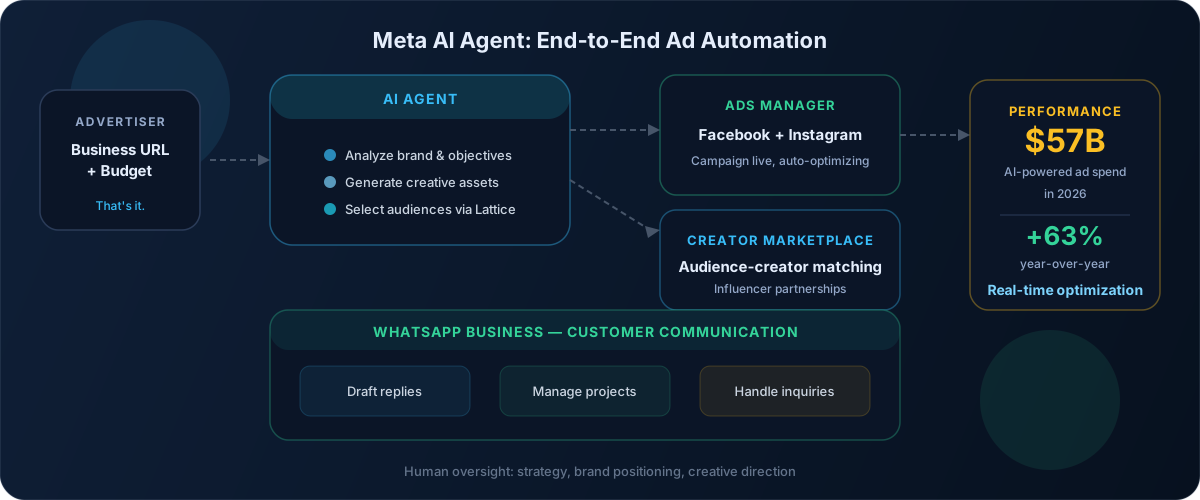
Meta rolled out AI agents inside Ads Manager this week that can run advertising campaigns from start to finish. An advertiser inputs a business URL and a budget, and Meta’s AI handles the rest — generating creative assets, selecting audiences, placing ads across Facebook and Instagram, and optimizing performance in real time. It’s the most significant shift in paid social advertising since programmatic buying.
What Changed
This isn’t Meta adding a “suggest copy” button. The new system integrates the full campaign lifecycle into autonomous agents that operate within Ads Manager and WhatsApp Business:
- Creative generation: The agent produces ad imagery, video, and copy based on the brand’s existing assets and objectives
- Audience targeting: Meta’s Lattice targeting system selects audiences autonomously, replacing manual demographic and interest-based targeting
- Creator matching: The agent evaluates audience-creator fit through Instagram’s Creator Marketplace, recommending or initiating influencer partnerships
- Customer communication: In WhatsApp Business, agents draft replies, manage projects, and handle customer inquiries
The integration with Meta’s Manus acquisition — completed just two months ago — is what makes this possible. Manus brought agentic AI capabilities that Meta has already embedded into its advertising infrastructure, moving from “AI-assisted” to “AI-operated.”
The Numbers
U.S. advertisers are expected to push $57 billion through AI-powered platforms in 2026, a 63% increase year-over-year. Meta is positioning itself to capture a disproportionate share of that spend by reducing the friction between “I want to advertise” and “my campaign is running.”
For small businesses especially, this eliminates the need for dedicated media buyers or agency relationships. A local business owner who previously needed to learn Ads Manager’s complexity — or hire someone who already knew it — can now describe their goal and let the agent execute.
The Automation Shift
Meta’s move accelerates a trend we’ve been tracking: AI agents rewriting the automation playbook. Advertising is a natural fit for agentic automation because the feedback loops are fast and measurable. The agent places an ad, measures performance, adjusts targeting or creative, and repeats — all within hours rather than the days or weeks a human team would take.
This mirrors what’s happening across enterprise workflows. The pattern is consistent: tasks that involve structured inputs, measurable outputs, and iterative optimization are the first to shift from human-operated to agent-operated. Automation before AI has been the conventional wisdom, but Meta is demonstrating that for well-defined domains, AI agents can handle both the automation and the decision-making simultaneously.
What Stays Human
Meta is careful to position this as augmentation rather than replacement — and the distinction matters. The media buyers thriving in 2026 are the ones using AI agents to eliminate execution busywork so they can focus on strategy: brand positioning, market timing, campaign architecture, and creative direction.
The risk isn’t that AI runs ads poorly. Early results suggest AI-generated campaigns perform competitively with human-crafted ones on direct-response metrics. The risk is that every competitor gets access to the same AI, compressing the performance gap between sophisticated and unsophisticated advertisers. When everyone’s campaigns are AI-optimized, differentiation shifts back to brand quality, offer strength, and strategic insight — things that remain stubbornly human.
What This Means
For businesses running paid social, Meta’s autonomous agents reduce operational overhead immediately. The question isn’t whether to use them — the competitive pressure will make that inevitable — but how to maintain strategic advantage when your competitors have the same tools.
For the broader enterprise AI adoption landscape, Meta’s rollout is a proof point. This isn’t a research demo or a limited beta. It’s autonomous AI agents operating at the scale of Meta’s advertising ecosystem — billions of dollars in daily ad spend, hundreds of millions of users, real business outcomes. That’s the kind of validation that accelerates adoption across other domains — from advertising to autonomous scientific research.
Meanwhile, the infrastructure costs of running AI at Meta’s scale continue to drop. Advances in extreme model compression are making it cheaper to serve the millions of inference calls that autonomous ad agents generate daily.
Coverage: Marketing Dive | ContentGrip