
Google Research published TurboQuant today, a compression algorithm presented at ICLR 2026 that reduces the memory footprint of AI model key-value (KV) caches by at least 6x — with zero accuracy loss. On H100 GPUs, 4-bit TurboQuant delivers up to 8x speedups over unquantized 32-bit inference. The implications ripple from hyperscale data centers down to local hardware.
The Problem TurboQuant Solves
Large language models store key-value pairs for every token in their context window. As context lengths grow — 128K, 1M, and beyond — these KV caches become the primary memory bottleneck. A model that fits comfortably in GPU memory at 4K context might exhaust VRAM at 128K, not because the model weights grew, but because the cache did.
Previous quantization approaches address this by compressing values to lower bit widths, but they carry overhead: storing quantization constants, calibration data, and lookup tables that eat into the memory savings. TurboQuant eliminates that overhead entirely.
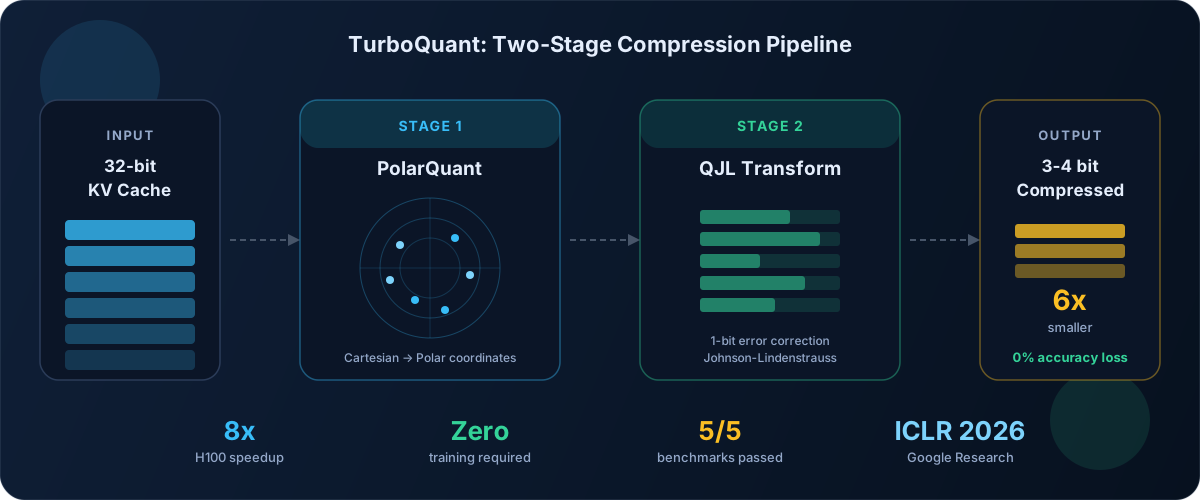
How It Works
TurboQuant uses a two-stage approach that’s elegant in its simplicity:
Stage 1 — PolarQuant. The algorithm randomly rotates data vectors, then converts them from Cartesian to polar coordinates (radius plus angles). This maps the data onto a fixed, predictable circular grid. Because the grid is deterministic, there’s no need to store quantization constants alongside the compressed data — the overhead that plagues traditional methods simply disappears.
Stage 2 — QJL (Quantized Johnson-Lindenstrauss). A 1-bit transform captures residual errors from the first stage. The key insight is a custom estimator that pairs high-precision queries with the low-precision compressed data, strategically balancing accuracy and efficiency.
The result: 3-bit or 4-bit quantization that requires no training, no calibration data, and no per-tensor bookkeeping.
Data Center Impact
The numbers at scale are striking:
| Metric | Result |
|---|---|
| KV cache reduction | At least 6x |
| Speedup (4-bit vs 32-bit, H100) | Up to 8x |
| Accuracy | Zero loss across all benchmarks |
| Training required | None |
TurboQuant was tested on Gemma and Mistral across five long-context benchmarks — LongBench, Needle In A Haystack, ZeroSCROLLS, RULER, and L-Eval — achieving perfect downstream results on all of them. That’s not “within acceptable margins.” It’s lossless.
For organizations running inference at scale, a 6x reduction in KV cache memory translates directly to either serving more concurrent users on existing hardware or extending context lengths without provisioning additional GPUs. At H100 prices — roughly $30K per unit — the cost implications are substantial. A workload that previously required six GPUs for long-context inference might now fit on one.
The 8x speedup on attention computation is equally significant. Attention is the core bottleneck in transformer inference, especially at long context lengths where the quadratic scaling of attention makes every optimization count.
Local and Edge Implications
While the paper focuses on H100 benchmarks, the underlying technique is hardware-agnostic — and its implications for local AI inference may be even more transformative.
Consumer GPUs and Apple Silicon devices have limited VRAM (8–24 GB typically). The KV cache is often what prevents running larger models or longer contexts locally. A 6x compression of that cache fundamentally changes the math:
- A model that currently maxes out at 16K context on a 16 GB device could potentially handle 96K+ contexts
- Models that require quantization of their weights to fit locally might instead run at higher weight precision while compressing only the KV cache
- The local inference ecosystem — llama.cpp, GGML, MLX — could integrate TurboQuant’s approach to unlock longer contexts without hardware upgrades
This matters for privacy-sensitive workloads, offline use cases, and the growing segment of developers who prefer running models locally. The gap between “what you can do in the cloud” and “what you can do on your laptop” just narrowed.
Beyond LLMs: Vector Search
TurboQuant isn’t limited to language model inference. The paper also demonstrates superior performance on vector search tasks, outperforming existing methods like Product Quantization (PQ) and RabbiQ on the GloVe dataset while dramatically speeding up index construction.
This has direct implications for RAG pipelines and semantic search systems, where vector databases store millions of embeddings that consume significant memory. Compressing those embeddings with zero recall loss while accelerating search would reduce infrastructure costs for any organization running retrieval-augmented generation at scale.
What This Means
TurboQuant represents a shift in how we think about AI efficiency. Previous compression research typically involved tradeoffs — accept some accuracy loss for better performance, or invest in expensive calibration to minimize degradation. TurboQuant’s claim of zero accuracy loss with no training requirement sidesteps that tradeoff entirely.
For cloud providers and enterprises: 6x memory reduction and 8x speedups on existing H100 infrastructure means dramatically lower cost-per-query for long-context workloads. As models move toward million-token contexts and agentic workflows that maintain long conversation histories, KV cache efficiency becomes a competitive advantage. Platforms running AI at massive scale — like Meta’s autonomous ad agents — would see immediate infrastructure savings from this kind of compression.
For local AI: The technique could be the key that unlocks practical long-context inference on consumer hardware. When the bottleneck isn’t model size but cache size, compressing the cache changes what’s possible without changing the hardware.
For research infrastructure: Efficiency gains like TurboQuant’s compound with the scale of compute being deployed. OpenAI’s push toward autonomous AI researchers running on hundreds of thousands of GPUs is exactly the kind of workload where 6x memory compression translates to millions in savings.
For the industry: If TurboQuant’s results hold up under broader independent testing, expect rapid adoption. The combination of zero accuracy loss, no training requirement, and dramatic speedups is rare in compression research. The question isn’t whether this approach will be integrated into inference frameworks — it’s how quickly.
Paper: TurboQuant: Redefining AI Efficiency with Extreme Compression (ICLR 2026, Google Research)