
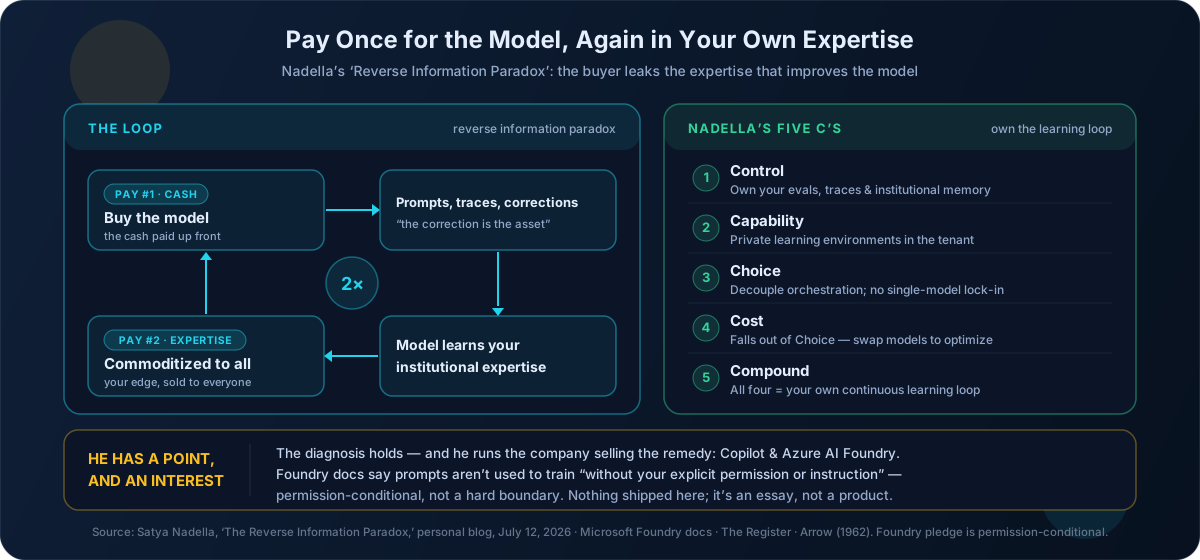
Satya Nadella published an essay called “The Reverse Information Paradox” on his personal blog on July 12, and it reads like a critic of the AI industry wrote it rather than the man who sells Copilot and Azure. The claim: businesses buying AI pay twice — once in money, and again in the proprietary expertise they hand over to make the model useful. He is right about the mechanism, and he runs the company best positioned to sell the remedy. Both need to stay in view.
The Inversion
Kenneth Arrow’s 1962 paper on the economics of invention holds the line Nadella works from, on page 615: “its value for the purchaser is not known until he has the information, but then he has in effect acquired it without cost.” That is the seller’s problem. Nadella flips the party: “In the AI age, the buyer risks giving away knowledge, just in order to use what they bought.”
What lifts this above wordplay is his account of the leak, which is not a breach and which no data-protection clause closes. Models learn from “exhaust,” he writes — “the prompts people write, the tools agents use, and especially the corrections people make when the model is wrong… the kind of knowledge a competitor could never buy, and the kind that leaks almost imperceptibly: trace by trace, correction by correction, eval by eval.” The correction is the asset. Every time someone tells the model it got the quote wrong and explains why, they produce the one training signal nobody can purchase. Arrow had the mechanism on that same page — “the very use of the information in any productive way is bound to reveal it, at least in part” — sixty-four years before there was enough compute to industrialize it.
He Was Making This Argument Before Karp Was
The essay lands eleven days after Palantir CEO Alex Karp told CNBC’s Squawk Box that of the frontier labs, “something has gone completely wrong. The basic view among enterprises in this country is I’m going to chillax and waste my time with tokens.” Nadella quotes him approvingly and links Palantir’s post.
The tempting read — Nadella joins the sovereignty pile-on — doesn’t survive the dates. His own June 14 post, seventeen days before Karp went on television, already asked how organizations “continue to learn, build IP, differentiate, and thrive in a world where AI models can continuously absorb the expertise of humans and organizations and commoditize it.” Earlier still, on November 15, he was warning that firms risk “inadvertently just transfer[ring] their unique value to the tech sector!!” Karp is corroboration he recruited, not a bandwagon he joined.
The Line Aimed at His Own Partners
The sentence that should have led every write-up: “While the great innovation that comes from model providers having fair use rights to train models on public data is needed, I find it ironic that the status quo is to then turn around and impose restrictive terms on distillation, and to reserve the right to learn from customer usage and interaction data.”
The asymmetry he is describing: the labs claim a fair-use right to learn from the public web, then forbid customers from learning from model outputs while reserving the right to learn from those customers. He names no lab and doesn’t need to. Microsoft put billions into OpenAI and was ChatGPT’s exclusive cloud home until the two loosened exclusivity provisions early this year, and last November it put $5B into Anthropic — alongside Nvidia’s up-to-$10B — with Anthropic committing $30B of Azure compute in return. Karp’s broadside named Anthropic and OpenAI; Nadella quoted it while Microsoft holds a position in both. The distillation claim is his characterization, though: he cites no clause and names no company, so hold it as an assertion until someone puts a contract on the table. The better-documented irony is in his own archive — eight months before calling those terms ironic, he wrote that “our investment helped them scale; their research accelerated our own innovation.”
The Interest, and What the Documentation Actually Says
The Register’s Brandon Vigliarolo, the only reporter who got Microsoft to respond, led with the obvious: “Seemingly unaware of the concept of irony, Satya Nadella is warning AI-using enterprises to take care not to give away their business secrets alongside the massive piles of cash they’re forking over to frontier labs every month.” A spokesperson agreed the problem was structural to hosted AI and pointed at Copilot and Azure AI Foundry as Redmond’s answer. This is a company position with a product attached.
Foundry’s data-privacy page says customer prompts, completions, embeddings and training data “are NOT used by providers of Models sold by Azure to improve their models or services” — Nadella’s warning, apparently pre-answered on his own platform. Three qualifiers say otherwise. The commitment against using your data to improve Microsoft or third-party products ends “without your explicit permission or instruction”: permission-conditional, not absolute. The page is documentation rather than a contract, and it names the Microsoft Products and Services Data Protection Addendum as the instrument that actually governs. And “model sold by Azure” is a defined term covering a class of deployments, not everything you can run on Foundry. The same page adds that when heuristics flag potential abuse, “a sample of customer’s prompts and completions may be selected for review,” with human reviewers as necessary — on by default, and managed customers must apply to modify it.
So the “hard boundary across which nothing crosses, not even the intelligence exhaust, without consent” doesn’t exist on Azure either. It is a thing he wants rather than a thing he ships — the nearest working consent primitive the industry has is the crawl layer, several floors below prompts and corrections. And every remedy in the essay still runs on somebody’s cloud, where the model is the part you can swap out and the tenant is the part you can’t.
Five C’s, and the One a 20-Person Company Can Use
The principles are Control, Capability, Choice, Cost, Compound. Control is “your private evals, because evals define what ‘good’ looks like inside the organization,” plus ownership of “your organization’s memory, traces, feedbacks, decisions, and institutional context.” Capability is building “proprietary learning environments within the tenant boundary.” Choice decouples orchestration from any single model, and its test is a pair of questions: “If any one model you are using is taken away, do you still have the ability to operate and optimize for your evals using other models? Does your company ‘veteran’ capability remain with you even if a given ‘generalist’ model is taken away?” Cost falls out of Choice; Compound is the four together, producing “your own continuous learning loop (i.e. hill climbing machine).”
Four of the five assume an ML team, a tenant boundary, and a platform budget — easier to say from Redmond than to execute on a small budget. Read as a to-do list by a 20-person company, this essay will cost you money in the wrong places; the build-versus-buy calculus hasn’t changed because a CEO wrote a blog post.
Control translates, and it’s the cheapest item on the list. An eval is a spreadsheet: fifty rows of real inputs — support tickets, quotes, intake forms — with the right answer beside each. It costs an afternoon, it’s unambiguously yours, and it’s the only way to answer his own test: without evals, switching models is a leap of faith; with them it’s a Tuesday. Keep the prompts and corrections in files you own, too, because when the library lives inside one vendor’s assistant, the switching cost is the library, not the model. On Choice, Karp’s remedy is the more actionable one — CNBC reported he views open-weight models as a potential solution for CEOs frustrated by the labs, and open weights let you hold the model rather than abstract over it, the case the open-source field lays out. Nadella’s Choice stops at the orchestration layer, which is where Foundry sells. Microsoft runs the principle on itself: seven in-house MAI models shipped at Build in June to cut OpenAI dependence.
The exposure most small businesses actually carry isn’t the one the essay describes. On paid business tiers the documentation generally commits against training base models on your prompts, with the qualifiers above; on free and consumer tiers the defaults often differ, and that gap is where SMBs get caught — someone pastes the pricing model into a personal chat account because the paid seat was never approved. That’s a governance problem rather than a paradox, and Grok Build’s repo uploads are what it looks like when it goes wrong.
The Argument, Minus the Sales Pitch
The diagnosis holds. Value accrues to whoever owns the learning loop, corrections are the highest-grade training signal a business produces, and almost nobody books them as an asset. The prescription is a roadmap — decouple the model from the harness, keep the harness inside a tenant — and Microsoft sells tenants. Nothing shipped here either; Copilot and Foundry already existed, and the spokesperson pointed at them rather than announcing anything. Take the argument and price the positioning.
His closing line is the fair version: “a company should be able to use a model without giving up the knowledge that makes it unique.” Should be able to is carrying most of the weight in that sentence. Nobody sells that today, Redmond included.
Key Details
| Item | Detail |
|---|---|
| Essay | ”The Reverse Information Paradox” |
| Author | Satya Nadella — no visible on-page byline; authorship declared in the page’s structured data, cross-posted to LinkedIn and X |
| Published | July 12, 2026, on snscratchpad.com — his fourth post there |
| Core claim | Buyers pay twice: in cash, and in the proprietary knowledge they must reveal to make the model useful |
| Five principles | Control, Capability, Choice, Cost, Compound |
| Intellectual source | Kenneth Arrow’s information paradox (1962, p. 615); Hayek’s “particular intelligence” |
| Labs named in the essay | None. He never names OpenAI or Anthropic |
| Microsoft’s position | Structural problem with hosted AI; Copilot and Azure AI Foundry named as Redmond’s answer (spokesperson to The Register, paraphrased — no verbatim statement exists) |
| Microsoft’s stake | Billions in OpenAI (former exclusive ChatGPT cloud; exclusivity loosened early 2026); $5B in Anthropic, November 2025 |
| What shipped | Nothing. This is an essay, not a product |
Sources
- The Reverse Information Paradox — Satya Nadella, snscratchpad.com
- A frontier without an ecosystem is not stable, June 14, 2026 — Satya Nadella
- Positive Sum Future, November 15, 2025 — Satya Nadella
- “Some thoughts on the Reverse Information Paradox” — Satya Nadella on LinkedIn
- The Reverse Information Paradox — Satya Nadella on X
- Microsoft chief turns hostile on frontier AI labs, warns companies to guard their IP — The Register
- Data, privacy, and security for Models sold by Azure in Microsoft Foundry — Microsoft Learn
- Economic Welfare and the Allocation of Resources for Invention, pp. 609–626 — Kenneth J. Arrow, NBER (1962)
- Palantir CEO Alex Karp on enterprise AI token spending, Squawk Box, July 1, 2026 — CNBC
- Microsoft, Nvidia and Anthropic announce strategic partnerships — Microsoft
- Palantir on Alex Karp’s remarks — @PalantirTech on X