Google announced Nano Banana 2.1 on October 6 with a post on X saying the model “outperforms our previous models across the board, with notable leaps in visual design, mask-based editing, and subject consistency”. Google on X It reached general availability the same day, as gemini-nano-banana-2.1, on the Gemini API and on Vertex AI (now branded Gemini Enterprise Agent Platform), with no preview phase, and the model card says it is “based on Gemini 3.6 Flash”. Gemini API changelog Vertex model page Nano Banana 2.1 model card When we checked at about 18:25 UTC there was no launch post on blog.google, the DeepMind blog or the Developers Blog and no Gemini app release note; the launch is a two-post thread on X, a model card and the developer docs.
Our Nano Banana 2 article covered the February launch, search grounding and the SynthID plus C2PA pairing, so none of that is repeated here. S5 Labs has not tested the model, and every benchmark figure below is Google’s own unless it is labelled Arena. Three things in the docs matter more to a team than the launch post: a price structure that roughly halves the cost per generated image while raising the per-token rates, a 23-day shutdown notice for Nano Banana 2 on the Gemini API, and the distance between “mask-based editing” on the model card and what the API exposes.
What changed from Nano Banana 2
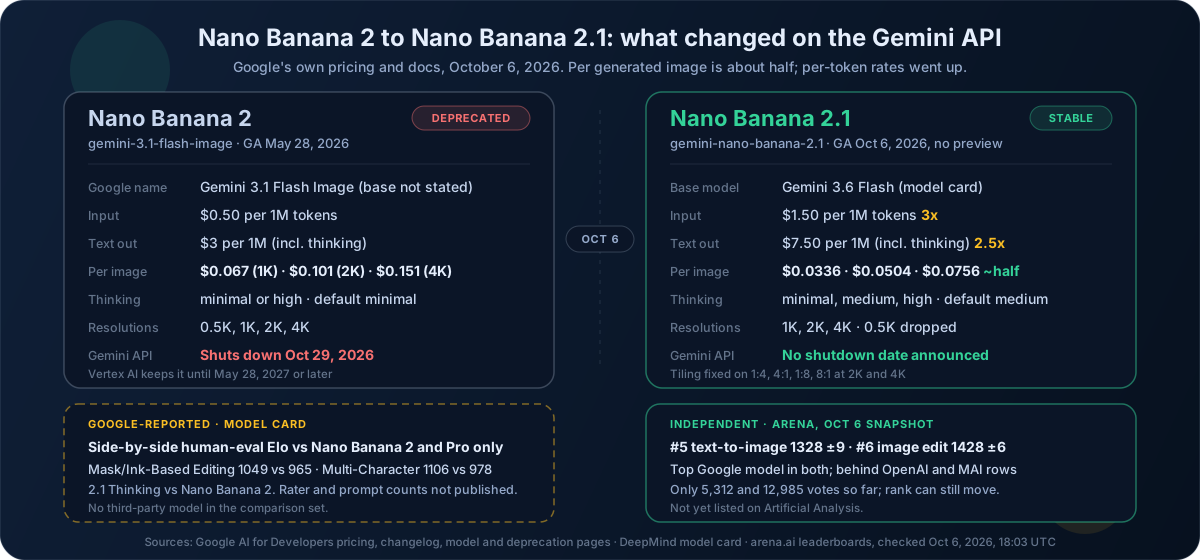
The changelog calls 2.1 “An update to Nano Banana 2 (gemini-3.1-flash-image)” that “maintains Flash-level speed and cost efficiency” with gains in visual quality, prompt adherence, multi-turn character consistency, text rendering and wide aspect ratios. Gemini API changelog “Flash-level speed” is the only speed statement Google makes; no latency figure is published. The base model appears only on the model card, which calls 2.1 “a member of the Gemini 3 series” built on Gemini 3.6 Flash. Nano Banana 2.1 model card
The concrete differences are in the image-generation guide. Thinking now has three levels, minimal, medium and high, with medium the default; Nano Banana 2 had minimal and high with minimal the default. Thinking cannot be disabled, and the model may produce up to two interim images that are not charged. Image generation guide The 0.5K (512px) resolution is gone: 2.1 outputs 1K, 2K and 4K only, and wide and panoramic ratios (1:4, 4:1, 1:8, 8:1) run at all three sizes. Image generation guide Gemini API changelog The model page lists “Fixed tiling artifacts” on those ratios at 2K and 4K. Nano Banana 2.1 model page
Reference-image limits did not move in the current docs. Both models take up to 14 images per prompt, with “character consistency for up to 4 characters and object fidelity for up to 10 objects”. Nano Banana 2.1 model page The guide’s reference-image table gives both models the same limits. Image generation guide Google’s February launch post gave Nano Banana 2 five characters and 14 objects, so the guide now lists a lower figure for the older model than Google did at launch. Google, Nano Banana 2 launch Inputs are text, image, video and PDF Nano Banana 2.1 model page, and the guide says audio input is not supported. Image generation guide Context is 131,072 tokens in and 32,768 out on both the Gemini API and Vertex; the model card’s “up to 1M” looks inherited from the base model and is not the API limit. On Vertex, setting seed, temperature, topP, topK or logprobs returns an error. Vertex model page
Per image is half; per token is not
The Gemini API price is $1.50 per million input tokens, $7.50 per million text and thinking output tokens, and $30 per million image output tokens. Output images cost 1,120, 1,680 and 2,520 tokens at 1K, 2K and 4K, which Google converts to $0.0336, $0.0504 and $0.0756 per image. Gemini API pricing Nano Banana 2 lists $0.067, $0.101 and $0.151 at the same sizes, so per generated image 2.1 is about half at every shared resolution. Batch is exactly half of standard for both models. The free tier shows “Not available” for 2.1.
The per-token side moved the other way. Input is three times Nano Banana 2 ($1.50 against $0.50) and text output is two and a half times ($7.50 against $3). Thinking tokens bill as text output, and the default level rose from minimal to medium, so a prompt-heavy editing session adds cost the per-image figure does not show. Vertex, where 2.1 is offered in the global region only, states that it “charges 1120 tokens per input image”, about $0.00168 per reference image against about $0.00056 for Nano Banana 2 at its global $0.50 rate; the Gemini API pages give no per-input-image count for either model. Vertex pricing A workflow that sends ten references and a long instruction to make one 1K image now pays more of its bill in input.
A discrepancy we could not resolve: Vertex meters a 4K image at 3,780 tokens, or $0.113, where the Gemini API says 2,520 tokens and $0.0756, so on Vertex the saving against Nano Banana 2 holds at 1K and 2K but shrinks to about 25% at 4K. Vertex pricing
Mask-based editing has a benchmark row and no API parameter
The announcement and the DeepMind product page name mask-based editing as a headline gain, and the model card benchmarks it. The card’s row is “Mask/Ink-Based Editing”, where 2.1 Thinking scores 1049 against 965 for Nano Banana 2 and 927 for Pro. Its limitations list “Partial instruction following and ink persistence in masked/doodle based editing”. Nano Banana 2.1 model card Read with the DeepMind demo prompt, “mask the object inside the sketch and place in a completely different environment but don’t change the size and position of the object itself”, that suggests a mark drawn on the image that the model should treat as a region and then not reproduce. Google does not spell out the mechanism. Google DeepMind
The API takes no mask: there is no alpha-mask upload and no mask parameter, and the only “mask” in the guide is section “2. Inpainting (semantic masking)”, which asks you to “Conversationally define a ‘mask’ to edit a specific part of an image while leaving the rest untouched”, with an example that sends one image and a two-sentence instruction: change only the blue sofa to a brown leather chesterfield, and keep the rest of the room unchanged. Image generation guide We found no Google page that documents a brush or mask tool for 2.1 in the Gemini app, Flow, Stitch or AI Studio.
In a production editing workflow the region is described in words or drawn into the pixels you send, and the docs state the intent to leave the rest untouched but give no guarantee or metric for it, so plan as if the model regenerates the whole frame. Our ChatGPT Images 2.5 piece argued for keeping every accepted version; add a diff of the output against the source outside the masked area, and score what moved that should not have. The Elo gain says raters preferred 2.1’s masked edits more often; it does not say the untouched region came back pixel-identical.
Subject consistency: three card rows and their limits
The largest gap over Nano Banana 2 on the card is Multi-Character Consistency: 1106 for 2.1 Thinking against 978 for Nano Banana 2 and 1011 for Pro, 128 points over the predecessor. Product Consistency is 1024 against 955 and Multi-Reference Editing 1066 against 988. Nano Banana 2.1 model card All are Google-run side-by-side human evaluations reported as Elo with a stated interval; rater counts, prompt counts, the confidence level and the Elo anchor are not published. On these rows 2.1 Thinking sits outside the stated intervals of Nano Banana 2 and Pro, while its Thinking and No Thinking results overlap on several rows, so thinking adds little that the card can show.
Those rows map onto three jobs: a product that has to survive a background, a crop and a copy change; a character that recurs across a campaign; and packaging or other brand assets that must not drift. Inside the four-character and ten-object ceilings, the card says “Character consistency is not always perfect between input images and generated output image” and reports “rare instances of persistent subject pose” in editing. It also lists “Poor text rendering in small text (often blurry in 1k model)”, so a brand asset with fine print should be tested at 2K or 4K rather than the 1K default.
”Across the board” means against Google’s own models
The model card compares 2.1 with two models, Nano Banana 2 and Nano Banana Pro. It leaves out the original Nano Banana, Nano Banana 2 Lite and every third-party model. On those terms the card’s table supports the claim: 2.1, with or without thinking, scores above both on all ten rows, by point estimate. Nano Banana 2.1 model card
The independent picture on launch day comes from Arena, whose leaderboard already carried gemini-nano-banana-2.1 when we pulled it at 18:03 UTC. In text-to-image it sits fifth at 1328 ±9 on 5,312 votes, behind gpt-image-2.5 Sunburst (1425), gpt-image-2.5 Flare (1398), gpt-image-2 (1383) and Microsoft’s MAI-Image-2.6 (1333), and 67 points above the 1261 of Nano Banana 2’s web-search row. In image edit it is sixth at 1428 ±6 on 12,985 votes, tied with MAI-Image-2.6, behind the three OpenAI rows and Grok Imagine Image 2.0, and 41 points above Nano Banana 2. Arena text-to-image Arena image edit So 2.1 is the best Google model on both boards and the best model on neither. The caveats: Arena lists variants (the Nano Banana 2 comparison row is its web-search variant, and gpt-image-2 is the medium setting), the vote counts are a fraction of Nano Banana 2’s 59,779 and 229,782, the rank spreads (4-6 and 4-7) overlap MAI-Image-2.6 and Grok, the gpt-image-2.5 rows are marked Preliminary, and Arena Elo is not comparable to the card’s Elo. Artificial Analysis had no 2.1 entry, and we found no hands-on test from a major outlet by 18:04 UTC. Artificial Analysis
Against ChatGPT Images 2.5, the only like-for-like number is Arena’s, and it favours OpenAI’s Sunburst and Flare rows by roughly 50 to 100 points in both arenas. MAI-Image-2.6 and Meta’s Muse Image belong on the same shortlist. None of this is a quality test on your brief, which no vendor has run.
Availability, the October 29 shutdown, and provenance
Google’s reply in the launch thread says 2.1 “starts rolling out today” across the Gemini app, AI Mode in Search, AI Studio, Flow, Stitch, Google Ads and “Gemini Enterprise Platform”. Google on X The model card’s distribution list adds the Gemini API. Nano Banana 2.1 model card For the consumer surfaces that list is nearly the whole disclosure: we found no plan, tier or region detail. Flow’s help page listed Nano Banana Pro, Nano Banana 2 Lite and Nano Banana 2 when we first checked; by 18:25 UTC it listed 2.1, “The standard model for fast, high-quality image generation and editing”, in place of Nano Banana 2. Flow help Rate limits for 2.1 are not in the public docs.
The deadline is the easiest item to miss. The changelog says “The gemini-3.1-flash-image model is deprecated and will be shut down on October 29, 2026. Migrate to gemini-nano-banana-2.1.” Gemini API changelog That is 23 days from the announcement and about five months after the model’s May 28 release. Gemini API deprecations It applies to the Gemini API only; Vertex lists gemini-3.1-flash-image retirement as “May 28, 2027 or later”. Vertex model versions The Nano Banana 2 model page shows no deprecation banner, so a developer who reads only that page will not see the date. gemini-nano-banana-2.1 itself has no shutdown date announced.
On provenance, the Gemini API guide says “All generated images include a SynthID watermark” and Vertex lists C2PA Content Credentials as supported, but the model card mentions neither, and we could not confirm whether C2PA metadata is embedded in images from the Gemini app, Flow or the Gemini API. Image generation guide Vertex model page Our watermarking guide covers what each mark does and does not prove.
What to check before switching
- Cost on real prompts. Re-run a week of traffic through the new rates: input at 3x, text and thinking output at 2.5x with medium thinking the default, images at about half. Try
thinking_levelat minimal and see whether the output still passes. - 0.5K and parameters. Anything built on 512px output needs a new size. Drop seed, temperature, topP, topK and logprobs on Vertex.
- Masked edits. Send the same region as a sentence and as a drawn mark, diff the untouched area against the source, and check that the ink does not persist.
- Consistency at the ceiling. Four characters and ten objects (within the 14-image limit) across at least three sequential edits, scored blind.
- 4K on Vertex. Confirm whether you are billed 2,520 or 3,780 tokens per image before quoting a client, and remember 2.1 runs in the global region only there.
- The date. Any production path still calling
gemini-3.1-flash-imagethrough the Gemini API stops on October 29.
Key Details
| Spec | Detail |
|---|---|
| Developer | Google DeepMind |
| Announced | October 6, 2026, 16:00 UTC, on X; model card and docs same day; no blog post found as of 18:25 UTC |
| Model ID | gemini-nano-banana-2.1 (Gemini API, Vertex AI); GA, no preview phase |
| Base model | Gemini 3.6 Flash (model card); not named on the API model page |
| Predecessor | Nano Banana 2, gemini-3.1-flash-image; shuts down on the Gemini API October 29, 2026; Vertex retirement May 28, 2027 or later |
| Surfaces | Gemini app, AI Mode in Search, AI Studio, Gemini API, Flow, Stitch, Google Ads (model card); Vertex AI / Gemini Enterprise Agent Platform, global region only (Vertex docs); consumer tiers and regions unpublished |
| Gemini API price | $1.50 in, $7.50 text and thinking out, $30 image out per 1M tokens; $0.0336 / $0.0504 / $0.0756 per 1K / 2K / 4K image; batch half; no free tier |
| Inputs and limits | Text, image, video, PDF; no audio; 131,072 in / 32,768 out; up to 14 reference images, 4 characters, 10 objects |
| Output | 1K, 2K, 4K (no 0.5K); ratios include 1:4, 4:1, 1:8, 8:1; thinking minimal / medium / high, default medium, cannot be disabled |
| Google-reported evals | Scores above Nano Banana 2 and Pro on all 10 model-card rows (side-by-side human-eval Elo, plus one AutoRater score; methodology unpublished) |
| Independent scores | Arena, October 6: #5 text-to-image (1328 ±9, 5,312 votes), #6 image edit (1428 ±6, 12,985 votes); no Artificial Analysis entry |
| Provenance | SynthID per Gemini API docs; C2PA Content Credentials per Vertex docs; neither on the model card |
Sources
- Meet Nano Banana 2.1 — Google on X
- Nano Banana 2.1 model card — Google DeepMind
- Nano Banana 2 product page with the 2.1 banner and demos — Google DeepMind
- Gemini API release notes — Google AI for Developers
- Gemini Nano Banana 2.1 model page — Google AI for Developers
- Image generation guide — Google AI for Developers
- Gemini API pricing — Google AI for Developers
- Model deprecations — Google AI for Developers
- Nano Banana 2.1 on Gemini Enterprise Agent Platform — Google Cloud
- Gemini Enterprise Agent Platform pricing — Google Cloud
- Model versions and retirement dates — Google Cloud
- Flow: available models — Google Help
- Nano Banana 2 launch post — Google
- Text-to-image leaderboard — Arena
- Image edit leaderboard — Arena
- Text-to-image leaderboard — Artificial Analysis