
The European Commission adopted two binding Digital Markets Act specification decisions against Alphabet on July 16, ordering Google to open the Android assistant layer to its competitors. DMA.100220, under Article 6(7), names eleven Android features Google must open to third-party AI services. DMA.100209, under Article 6(11), orders Google to license Search ranking, query, click and view data to eligible rivals on FRAND terms, and says outright that AI chatbots count. The Commission had six months from the opening of proceedings on January 27; it landed eleven days early.
Neither decision carries a fine, and neither changes anything on a phone before 2027.
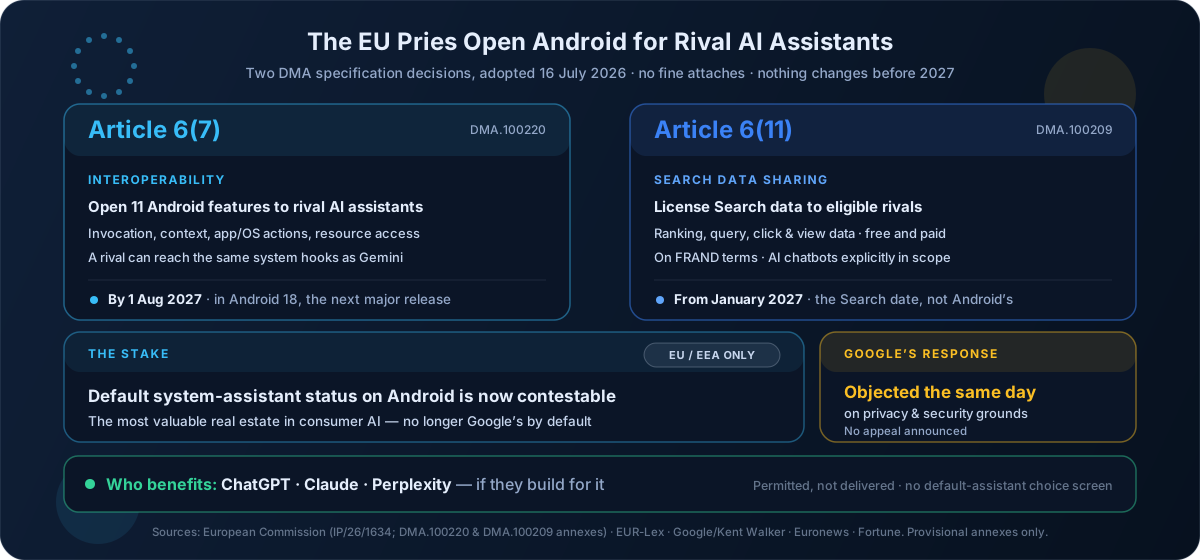
What the Commission Actually Ordered
The eleven features fall into four categories in the Commission’s own annex: invocation, context, actions on apps and the OS, and resource access. Invocation is the pair that matters most — contextual invocation from a long-press on the home button or the navigation handle, and always-on hotword detection, which is to say a rival’s wake word. The other nine are the machinery that separates an assistant from a chat window: centralised access to apps’ on-device data, context-aware intelligence, ambient data, structured on-device integration, screen automation, system integration, on-device models and their implementation, and background execution.
The Search scope is “ranking, query, click and view data in relation to free and paid search generated by end users,” minus account information, search histories, precise timestamps and paid-result URLs. Paragraph 2 forecloses the obvious dodge: Alphabet “shall not exclude third-party undertakings, such as undertakings providing AI chatbots with OSE functionalities” that meet the online-search-engine definition. A chatbot with a search box is a search engine here.
The Dates Nobody Is Getting Right
January 2027 is the Search date and only the Search date. Android runs on a different clock: all eleven features must ship in “the next major Android release, i.e. Android 18, and by 1 August 2027 at the latest” — a phrase the annex repeats at eleven separate paragraphs, once per feature. July 2027 is the Commission’s user-facing framing; August 1 is the legal backstop.
One measure doesn’t make even that. Measure 15(f), requiring that hotword detection from multiple services “including services belonging to third parties and Alphabet” be able to run concurrently, slips to Android 19 and “1 August 2028 at the latest” — and then only “within the technical capabilities of the device,” which matters because the annex notes hotword detection is DSP-based and depends on OEM hardware choices. A rival’s wake word does work in 2027, on a locked screen and in battery-saver mode; running it alongside Google’s is not guaranteed until 2028. That gap is the difference between trying a competing assistant and adopting one.
And no fine attaches to any of it. In the Commission’s own language, specification proceedings “are distinct from non-compliance investigations” and “do not provide for the imposition of fines.” That is worth stating plainly, because aggregators ran “EU Fires Record DMA Fine at Google” on this same date. A record fine over Search self-preferencing and the Play Store is separately reported and expected — sources told AFP it could land the following week — but that is a different case. Non-implementation is fineable at up to 10% of worldwide turnover, with daily penalties up to 5% of average daily turnover, only through a later non-compliance decision nobody has opened.
Invocation Is the Real Estate
Default assistant status is the most valuable position in consumer AI and it isn’t close. Whatever answers when you hold the home button or say the word gets the session; everything else is an app you have to remember to open. It is why Apple reportedly pays around $1 billion a year for a custom Gemini model to sit behind Siri, why Amazon put its agent inside its own search bar instead of shipping another chatbot, and why Google’s Gemini — whose next Pro model is itself months late — holds the spot on Android, which the Commission puts at 60% of EU users, an assertion offered without a baseline.
So it matters how far this goes, and it goes less far than the headlines suggest. There is no default-assistant choice screen, nothing like the Article 6(3) ballot Europeans got for browsers. What there is: Google “shall ensure that users can easily select which app is invoked through any access point,” through a mechanism that “must be non-discriminatory, including in terms of user interface”; Google may not reserve any access point for itself; hotword control must live in non-discriminatory central settings. That is an even-handed selection mechanism a user has to go and find, not a prompt that asks them. Whether ChatGPT, Claude or Perplexity becomes a system-level assistant on Android rather than a sandboxed app is a possibility this decision permits, not an outcome it delivers.
Google’s Objection Runs Into a Symmetry Clause
Kent Walker, Alphabet’s president of global affairs, objected the same day: “Today’s decisions risk undermining vital privacy and security guardrails for millions of Europeans.” The Android ruling, he said, “threatens device security by granting external apps sensitive and powerful device permissions without these safeguards.” On Search: “Europeans’ private searches would be exposed to unfamiliar companies, without adequate anonymisation of the data and without user knowledge or consent.”
Take it seriously; don’t take it at face value. Google has not announced an appeal — the post says only that it “will continue advocating for a balanced approach.” And “without these safeguards” is contestable on the face of the document: the annex carries consent, integrity and certification regimes, the Search decision lets Google vet a third party for cyber security and data protection risks before sharing anything, and the anonymisation was built alongside the European Data Protection Board’s draft joint DMA/GDPR guidelines. Nor does Google hold the certification keys — independent Trusted Certification Authorities issue the “Qualified AI Assistant” credential, and Google “shall accept” their certifications “without imposing further requirements.” Users can consent their way out of certification per service, which cuts both ways.
Safeguards exist; the dispute is over paragraph 115, which says that “Alphabet shall not impose a higher level of integrity on third parties than it applies to itself.” Google keeps the right to protect the device and loses the right to protect it more carefully from OpenAI than from Gemini. “Opening this up is dangerous” is what every incumbent says about interoperability, and it is sometimes true — the same argument is running at the web layer over agent access, where the security case and the moat case are hard to pull apart. Paragraph 115 doesn’t settle which one this is; it just makes Google’s own bar the evidence.
Who Can Take the Data
Not everyone qualifies: a beneficiary has to clear the sanctions and third-country-control screens, run at least 50,000 monthly average EU users, and either have provided search in the EU for two consecutive years or been founded within the last two with more than €50 million raised. Paragraph 89, which nobody is quoting, then caps the price: SMEs under the EU’s own definition can never be charged more than Google’s incremental cost plus a return capped at Alphabet’s WACC — no exceptional margin, ever. The Commission has priced a small challenger into Google’s search data on purpose. All of it is EU and EEA only; nothing here compels one byte of change to an Android phone in Ohio.
The Reasoning Isn’t Public Yet
Only the measures annexes are published, both marked provisional non-confidential, passages redacted. The reasoned decisions — the Commission’s evidence, and its answers to Google’s security case — arrive “at a later stage,” so the strongest version of Walker’s argument cannot yet be tested against the strongest version of the Commission’s. The decision is also explicitly amendable: the Commission may revisit the anonymisation measures based on market developments and independent evaluation, which is the one thing in the package Walker agrees with, since he asks for precisely that evidence-based flexibility.
The same Commission that spent six months specifying a competitor’s operating system, and beat its own deadline by eleven days, pushed its own high-risk AI rules back to December 2027 two months ago. It is far more comfortable telling one company what to build than telling an industry what not to.
Key Details
| Spec | Detail |
|---|---|
| Decisions | DMA.100220 (Art. 6(7), Android AI interoperability); DMA.100209 (Art. 6(11), Search data sharing) |
| Adopted | 16 July 2026 under Article 8(2) DMA — 11 days before the 27 July deadline |
| Android features opened | 11, across invocation, context, actions on apps/OS, and resource access |
| Restricted features | 5 of 11, requiring “Qualified AI Assistant” certification |
| Android deadline | Android 18, by 1 August 2027 at the latest (EC frames user-facing date as July 2027) |
| Concurrency exception | Measure 15(f), concurrent hotword detection — Android 19, by 1 August 2028 |
| Search data | Sharing from January 2027; access within 10 days of licence signature and price acceptance |
| Search data scope | Ranking, query, click and view data, free and paid; AI chatbots explicitly in scope |
| Eligibility | 50,000+ monthly avg EU users, plus 2 years in market or founded <2 years with >€50M raised |
| Certification timeline | Draft terms 1 Feb 2027; final terms and applications 1 May 2027 |
| Fine attached | None — specification proceedings cannot impose fines |
| Non-compliance exposure | Up to 10% of worldwide turnover (Art. 30(1)(b)); up to 5% of average daily turnover per day (Art. 31(1)(a)) |
| Geographic scope | EU/EEA only |
| Appeal | Not announced; decisions “remain subject to independent judicial scrutiny” |
Sources
- Commission provides guidance to Google for AI interoperability on Android and sharing of Google Search data under the Digital Markets Act — European Commission, IP/26/1634
- Case DMA.100220 — Alphabet, Android, Article 6(7), Final Measures annex (16 July 2026)
- Case DMA.100209 — Alphabet, Article 6(11), Final Measures annex (16 July 2026)
- Regulation (EU) 2022/1925 (Digital Markets Act) — EUR-Lex
- The DMA should not undercut security & privacy for Europeans — Kent Walker, Google
- EU orders Google to share search data, open Android to AI rivals — Euronews
- Alphabet specification proceedings: interoperability with AI services — EC developer portal
- EU tells Google to share search data with rivals from 2027 — Fortune