
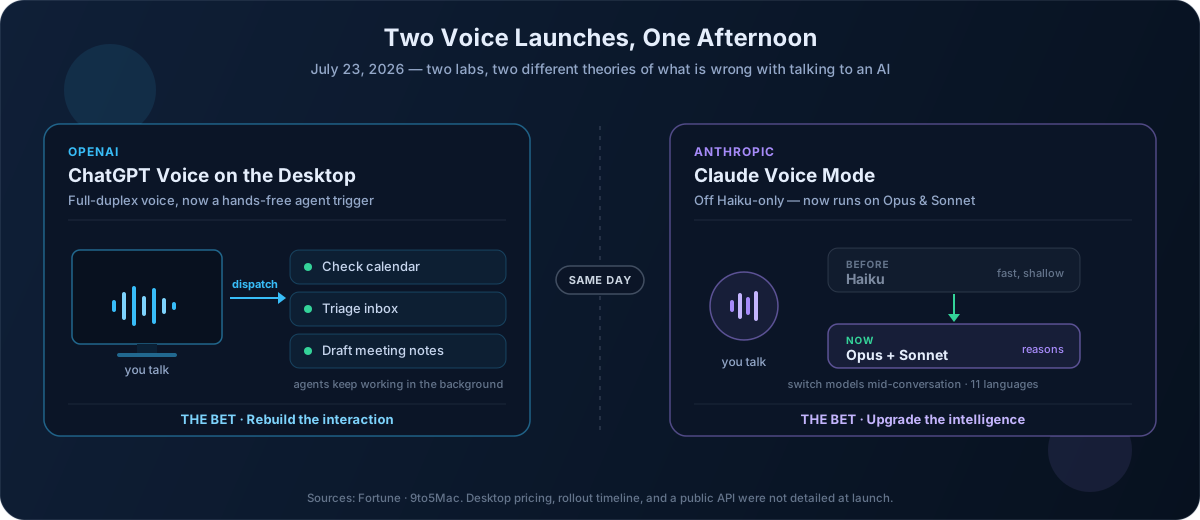
OpenAI brought ChatGPT Voice to its desktop app on July 23, extending the GPT-Live full-duplex model it had shipped on mobile two weeks earlier. On a phone, that model was a better conversation. On the desktop it is something else: a hands-free way to start work and walk away from it. You hold a hotkey, talk through what you need, and ChatGPT begins moving several tasks forward in the background while you do something else. OpenAI’s framing — “moving multiple tasks forward at the speed of your thought” — is marketing, but the product under it is not just a bigger screen for voice mode. Voice on the desktop is being pitched as a trigger for agents.
The same day, Anthropic upgraded Claude’s voice mode to run on Opus and Sonnet for the first time; until today it ran only on Haiku, the fast, shallow model in the lineup. Two labs, one afternoon, two theories of what is wrong with talking to an AI. OpenAI is rebuilding the interaction — full-duplex timing, hands-free dispatch, work that continues after you stop talking. Anthropic is fixing the intelligence behind the voice and leaving the interaction mostly alone. Each picked a real half of the problem. Neither shipped both.
What OpenAI Shipped Today
The launch is narrow on paper and broad in intent. ChatGPT Voice now runs inside the desktop app, summoned by a hotkey so you can talk to it without leaving whatever you are working in. The capability OpenAI is actually selling is dispatch: from a single spoken conversation you can kick off several work streams at once and let agents finish them in the background. The example in OpenAI’s own materials is mundane on purpose — ask it to check your calendar for conflicts, comb your inbox for flight changes, and prepare notes for your meetings, all while you make coffee.
That puts the desktop release in the same lane as ChatGPT Work, OpenAI’s enterprise agent surface, and it is aimed squarely at power users — programmers especially, the people already burning the most tokens on code and the most likely to want to describe a change out loud and have it drafted while they keep reading. OpenAI is also pitching document creation and outlining from spoken concepts. The through-line is that the voice is not the destination; it is the fastest way to hand off.
As with the mobile launch, the announcement is thin on the details that matter to buyers. There is no disclosed consumer pricing for the desktop feature, no firm rollout timeline, and — consistent with GPT-Live two weeks ago — still no public API. This remains a consumer and prosumer feature you talk to, not a primitive developers can build on.
Why the Desktop Changes the Pitch
Move the same model from a phone to a desktop and the product quietly changes category. On mobile, GPT-Live was a companion you talked to. Behind a hotkey on a machine you are already working on, it becomes a command surface, and the bet is that the natural way to start agent work is not typing into a box but saying what you want.
That is a logical extension of GPT-Live’s own architecture. When the full-duplex models launched, GPT-Live was already a fast conversational layer that handed hard queries to a heavier model running in the background. The desktop release stretches the same split one step further: the fast voice layer now dispatches not just to a reasoning model but to agents that keep working after the sentence ends. It is the voice-first version of an idea Anthropic has been shipping for a while — Cowork’s Dispatch, which lets you assign work and come back to it done — and of the broader move to treat agents as the new unit of automation.
The catch is the one that shadows every background-agent pitch, and voice makes it sharper. When you dispatch work by talking and then look away, you are authorizing multi-step actions you will not watch, kicked off by a conversational layer that — by GPT-Live’s own design — is not the model doing the reasoning. The distance between what the voice heard and what the agent actually did is the entire risk surface, and a hotkey lowers the friction to open it. OpenAI also still has not shipped screen sharing, video, or an API for this generation. On the desktop that first gap bites hardest: the screen is the context, and a voice assistant that cannot see what you are looking at is running the work-alongside-you pitch with its eyes closed.
Claude Picks the Same Day
Anthropic’s move is smaller and aimed at a different bone. Claude’s voice mode now runs on Opus and Sonnet; until July 23 it ran only on Haiku, which favors instant answers over thinking. You can switch models mid-conversation, route voice through connectors to reach other tools, and work across eleven languages, on mobile, desktop, and web. 9to5Mac called it “long-overdue,” which is fair — it closes a gap paying users had complained about for months.
The contrast is why it belongs in the same story. OpenAI spent its effort on the interaction layer; Anthropic spent its on the substance layer, putting an Opus-class model behind the voice instead of the cheapest one available. Claude voice is still turn-based — no full-duplex claim here — but it fixed the thing that made voice assistants feel dumb: the model answering was the weakest one the lab makes. A voice you can interrupt that answers shallowly and a voice you take turns with that reasons well are broken in opposite directions. Today each lab fixed the half it had been ignoring.
What Decides This
The thing to watch is adoption of the desktop dispatch model, not a benchmark. Hands-free agent triggering either does real work or it stays a demo, and which one depends on whether people will authorize unwatched, multi-step work by voice once the novelty wears off. The likely outcome is that it lands for narrow, low-stakes dispatch — calendar, inbox triage, first drafts — and stalls when the stakes rise, because talking is a poor interface for reviewing what an agent is about to do before it does it.
The other thing to watch is whether either lab closes its own gap. OpenAI needs screen and video context so desktop voice can see the work it is being asked to act on. Anthropic needs full-duplex timing so an Opus-quality answer can arrive inside a real conversation instead of a walkie-talkie exchange. Whoever reaches smart, live, and able to act at the same time owns the surface. Today, on the same afternoon, both mostly showed which piece they are still missing.