
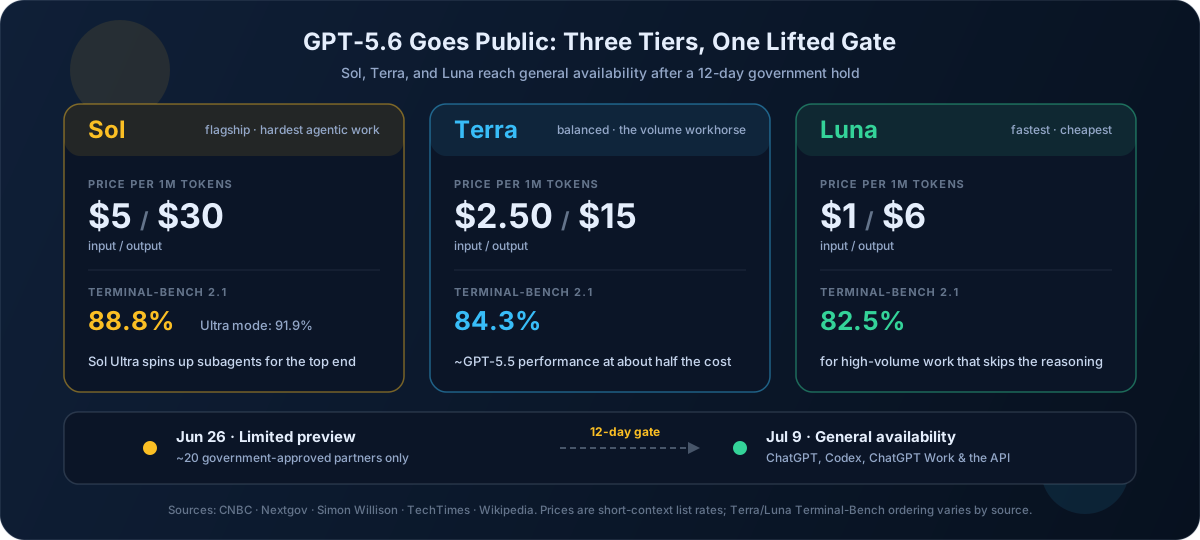
Update, October 15, 2026: The prices below were OpenAI’s launch rates on July 9, and all three have since come down. On July 30 OpenAI cut Terra by 20% and Luna by 80%, to $2/$12 and $0.20/$1.20 per million input and output tokens at standard short-context rates. On August 21 Sol dropped to $4/$20, which OpenAI calls promotional pricing “available at least through November 21, 2026.” OpenAI API changelog OpenAI API pricing The table, the tier graphic and the price comparisons in this article still show the launch figures. OpenAI has also released GPT-6 Sol and Luna, and its pricing page now lists GPT-5.6 Terra and Luna only under “All models.”
OpenAI flipped GPT-5.6 from a government-gated preview to a public product this week. The Sol, Terra, and Luna tiers that shipped on June 26 to roughly 20 vetted partners — and no one else — reached general availability across ChatGPT, Codex, and the API, with the broad rollout beginning July 9 and completing over about a day. The model family did not change. What changed is who is allowed to touch it.
Twelve days earlier, GPT-5.6 was the first US frontier model launched under a government-managed access list: a customer-by-customer approval process run out of the Commerce Department while OpenAI’s own executives argued the arrangement should not stick. The GA announcement is the other bookend. It tells you how long the review actually took, how OpenAI framed the outcome, and how little the White House was willing to sign its name to.
What Actually Lifted
The gate, not the model. GPT-5.6 remains the three-tier family OpenAI previewed: Luna as the cheapest and fastest tier, Terra as the balanced production model, and Sol as the flagship for hard agentic work, with a Sol Ultra variant that spins up subagents for the top of the range. All three are now buyable through the API and reachable inside ChatGPT and Codex without a partner invitation.
Pricing landed where the preview had already published it — standard per-million-token rates on the short-context tier:
| Tier | Input (per 1M) | Output (per 1M) |
|---|---|---|
| Sol | $5.00 | $30.00 |
| Terra | $2.50 | $15.00 |
| Luna | $1.00 | $6.00 |
Terra is still the line that matters for anyone running volume. OpenAI positions it at roughly GPT-5.5-level performance for about half the cost, which is the kind of move that resets unit economics on high-throughput workloads rather than winning a leaderboard. Luna undercuts it again for tasks that don’t need the reasoning headroom. Sol holds flagship pricing flat at GPT-5.5’s old $5/$30.
GA also brought the platform features a preview shortlist didn’t need published: Programmatic Tool Calling, which lets the model orchestrate tools with JavaScript instead of round-tripping every call through the prompt; native multi-agent and subagent support; explicit prompt-cache breakpoints with a 30-minute minimum cache life; and an “original” image-detail option. Prompt caching bills cache writes at 1.25x the uncached input rate and keeps roughly a 90% discount on cache reads, which is meaningful only if your traffic actually reuses context inside that 30-minute window.
The 12-Day Gate, Reviewed
Here is the useful number. The preview opened June 26; general availability began July 9. The government hold lasted about twelve days, which TechTimes framed as a “12-day White House gate.” For a process with no published criteria, no fixed clock, and no clear appeal, twelve days is fast. It is also the wrong thing to generalize from.
The review ran through the Commerce Department’s Center for AI Standards and Innovation. OpenAI sent technical staff to Washington, federal reviewers flagged concerns to resolve, and Commerce Secretary Howard Lutnick, Treasury Secretary Scott Bessent, and National Cyber Director Sean Cairncross were named in the process. Sam Altman described it to CNBC as a “collaborative back and forth.” That framing is doing work: a lab that opposes the mechanism describing the mechanism as painless, because the alternative framing is that a federal office decided when its flagship could ship.
Two things keep the “government approved it” story from being true as stated. OpenAI has said plainly that the vetted-partner approach should not “become the long-term default,” so it is not defending the process it just completed. And the White House told CNBC it gave OpenAI no “green light, approval or clearance,” and that release decisions “rest entirely with the companies.” Both sides, in other words, decline to call this an approval. That is not modesty. If neither the regulator nor the regulated will describe the gate as a licensing decision, the twelve-day turnaround tells you the review can be fast. It does not tell you what the review is.
The precedent traces to a June 2026 Trump executive order asking major developers to voluntarily submit frontier models for government safety evaluation, an impetus nextgov ties partly to Anthropic’s cybersecurity-focused Mythos work. GPT-5.6 Sol is tuned for biology, chemistry, and cybersecurity, and OpenAI says its safeguards can withstand “real-world adversarial pressure.” Whether the next model gets twelve days or twelve weeks is the question the GA date does not answer. We covered the government-gated preview itself in June; the distance between that story and this one is that the framework produced a fast release, out of a process nobody will formally name.
Where the Tiers Actually Land
On the agentic command-line benchmark Terminal-Bench 2.1, the ranking OpenAI foregrounds puts Sol Ultra on top with the mid-tiers close behind:
| Model (Terminal-Bench 2.1) | Score |
|---|---|
| GPT-5.6 Sol — Ultra (subagents) | 91.9% |
| GPT-5.6 Sol — single agent | 88.8% |
| GPT-5.6 Terra | 84.3% |
| GPT-5.6 Luna | 82.5% |
Treat the Terra-versus-Luna ordering loosely. Sources disagree on which of the two posts 84.3% and which posts 82.5%, so the gap between the balanced and budget tiers is narrower than any single table implies. The more interesting results sit elsewhere. On Agents’ Last Exam, which spans 55 professional fields, Sol scored 53.6, about 13 points clear of Anthropic’s current-generation Claude, with Terra and Luna reportedly beating that Claude model at a fraction of the cost per Simon Willison’s writeup. Altman told CNBC Sol achieves roughly 54% greater token efficiency on agentic coding tasks, which matters more to a bill than a benchmark does, if it holds in production.
The counter-example is SWE-Bench Pro, where Anthropic’s model lands near 80% against Sol’s 64.6%. OpenAI publicly questioned that benchmark’s reliability, which is the reaction every lab has to the test it loses. The honest read is that GPT-5.6 leads on agentic and command-line work and trails on at least one software-engineering benchmark, and that the Claude comparison is muddier than the charts suggest: the competing model is referred to as both “Fable 5” and “Mythos” across sources, so any single head-to-head figure is directional at best. Willison’s hands-on notes put Sol’s context window at 1 million tokens with a February 2026 knowledge cutoff; other write-ups claim more on both counts, and those figures are unconfirmed.
The 48-Hour Window
The timing is the other story. GPT-5.6 hit GA inside the same roughly 48-hour stretch as two other releases. OpenAI shipped GPT-Live, a full-duplex voice architecture the day before, and SpaceXAI put Grok 4.5 into public release that same July 8. Grok 4.5 is the sharper pricing threat on paper: $2 input and $6 output per million undercuts Sol’s $5/$30 and matches Luna’s output rate while beating it on input. Whether it competes with Sol on capability is a separate argument, and Elon Musk’s “Opus-class” description is a claim, not a result.
For enterprise buyers, the launch that matters as much as the model is ChatGPT Work, OpenAI’s agent surface for organizations, which reached general availability in the same window. GPT-5.6 is the engine; ChatGPT Work and Codex are two of the products it now runs inside. Reading the three as one release is closer to how OpenAI is actually shipping.
What To Watch
The number to track is not Sol’s Terminal-Bench score. It is the turnaround on the next frontier model that trips the executive order’s “covered” threshold. Twelve days was fast, but it was also the first run through the process, with a lab that cooperated, executives on a plane to Washington, and a White House motivated to show the framework works without calling it a license. None of those conditions are guaranteed to repeat, and OpenAI has already said it wants a different arrangement.
For teams choosing a model today, the practical change is simple. Terra is now buyable, and at $2.50/$15 for near-GPT-5.5 performance it deserves a real evaluation against whatever you run in high volume now. Sol is the pick for the hardest agentic work if its token-efficiency claim survives contact with your own traffic. The gate lifting is the headline; the pricing on Terra and Luna is the thing that will actually move production workloads. What nobody can price yet is how long the next model waits, and who decides.
Sources
- OpenAI to publicly release GPT-5.6, ending government limits — CNBC
- OpenAI gets US regulatory approval for GPT-5.6 rollout, Axios report says — CNBC
- OpenAI’s advanced GPT-5.6 models to be available to the public — Nextgov
- The new GPT-5.6 family: Luna, Terra, Sol — Simon Willison
- GPT-5.6 Goes Public After 12-Day White House Gate — TechTimes
- GPT-5.6 — Wikipedia