
On July 20, U.S. District Judge Araceli Martínez-Olguín granted final approval to Anthropic’s $1.5 billion settlement with a class of book authors and publishers — the largest copyright settlement in U.S. history. The headline number is the one that will travel. It is not the one a business should write down.
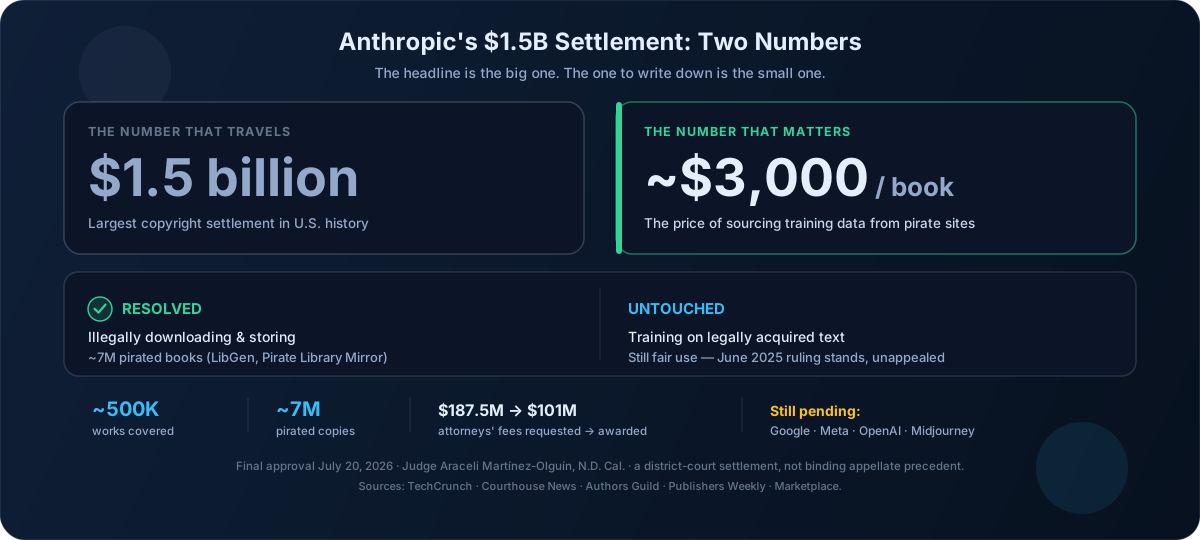
The number to keep is $3,000. That is roughly what each of about 500,000 works will earn its rightsholder, and it is the adjudicated price of one specific decision: sourcing training data from pirate sites instead of licensing it. The settlement does not say AI training is illegal. It says stealing the books first is expensive.
What the Settlement Does and Doesn’t Cover
This is the part almost every summary blurs, so it’s worth being precise. The case, Bartz v. Anthropic, was split into two questions a year ago, and only one of them was settled here.
In June 2025, Judge William Alsup ruled that training Claude on legally acquired books is fair use — “exceedingly transformative,” in his words. That finding stands, untouched by this settlement. What Alsup sent toward trial was the other half: Anthropic had downloaded roughly 7 million books from the pirate libraries Library Genesis and Pirate Library Mirror and kept them in a permanent internal library. Acquiring and storing pirated copies, the court held, is not fair use, and the statutory-damages exposure on that claim could have dwarfed $1.5 billion in front of a jury. Anthropic settled rather than roll those dice.
So the settlement resolves the theft, not the training. A business using Claude, ChatGPT, or any mainstream commercial model has no new legal reason to stop because of this ruling. The activity a court just blessed as fair use — training a model on text you legitimately obtained — is exactly the activity these products are built on. What got the $1.5 billion price tag was the sourcing shortcut, and that is a narrower and more useful lesson than “AI has a copyright problem.”
The Mechanics
The class covers roughly 500,000 distinct works, filtered down from the ~7 million pirated copies after removing duplicates, foreign editions, and unregistered titles. Each eligible work draws about $3,000 — a little over four times the $750 statutory minimum for ordinary infringement, which tells you the court treated this as meaningfully more than a paperwork violation. Anthropic is required to destroy the original pirated files within 30 days of final judgment.
Judge Martínez-Olguín — who inherited the case after Alsup retired at the end of 2025 — overruled objections that the deal was too small, writing that it “provides meaningful relief” given that “further litigation would likely be complex, expensive, lengthy, and risky.” She also trimmed the plaintiffs’ attorneys’ fees from the roughly $187.5 million requested to about $101 million. Anthropic says more than 91% of covered rightsholders have already claimed their payment; roughly 350 class members opted out to pursue Anthropic on their own.
For a company that filed to go public at a $965 billion valuation in June, $1.5 billion is a survivable line item — closer to a cost of doing business than an existential threat. That asymmetry is part of the story. The firms with the balance sheets to absorb a settlement like this are the ones that can afford to have cut the corner in the first place.
It’s a Price Tag, Not a Precedent
One district-court settlement sets no binding appellate law. The fair-use question that actually governs the industry — can you train on copyrighted material, and under what conditions — was decided in Anthropic’s favor at the trial-court level and has not been tested on appeal. This settlement doesn’t change that in either direction. It resolves one company’s exposure on one claim.
And the broader fight is very much live. Authors and publishers — including Hachette, Cengage, Elsevier, and novelist Scott Turow’s group — sued Google over Gemini’s training data on July 10, and sued Meta on similar grounds in May. Cases against OpenAI and Midjourney continue. Bartz is the first of that wave to produce a concrete dollar figure, which is why it matters, but it is a data point in an unsettled area, not the final word. We flagged the same collision when Bytedance’s Seedance video model ran straight into a copyright war; the training-data question is now doing to text what that did to video.
What a Small Business Should Take From This
Internalize the $3,000, not the $1.5 billion — because the small number is the one you can actually use. It’s a real, adjudicated cost for a specific failure mode (illegal data sourcing), and that makes it leverage the next time you’re reading an AI vendor’s contract.
Three things follow from it. First, ask any AI vendor — especially a smaller or newer one without Anthropic’s balance sheet — how its training data was sourced, and whether it will contractually indemnify you against copyright claims tied to that data. The large labs increasingly offer this; the question is a fast way to sort a serious vendor from a hopeful one. Second, understand that this settlement covers Anthropic’s exposure, not yours. If you’ve built a product on a model whose training corpus turns out to be tainted, your indemnification clause — or its absence — is what determines whether a spillover claim reaches you. That clause belongs on the checklist with everything else in your AI governance file, and it’s a core reason the build-versus-buy decision on AI now carries legal weight, not just cost and control. Third, don’t read this as the copyright question being closed. With Google, Meta, OpenAI, and Midjourney all still in litigation on the same theory, vendor risk here is moving, not fixed — the right posture is a contract that protects you regardless of how the next ruling lands, not a bet on which way it will.
A Receipt, Not a Verdict
The settlement is a milestone mostly for authors: 500,000 works, real money, a court affirming that “we’ll train on it anyway” doesn’t extend to pirating the source material. For the AI industry it is smaller than the number suggests — a rich company paying to make a discovery problem go away while the fair-use ruling it actually cares about stays intact. For everyone buying AI downstream, it’s neither a warning to retreat nor a reason to relax. It’s a receipt. File it with your vendor contracts, and use it the next time someone asks you to trust a model whose training data nobody will describe.
Key Details
| Item | Detail |
|---|---|
| Ruling | Final approval, July 20, 2026 |
| Judge | Araceli Martínez-Olguín (N.D. Cal.) |
| Amount | $1.5 billion — largest U.S. copyright settlement |
| Works covered | ~500,000 distinct titles |
| Per-work payout | ~$3,000 (≈4× the $750 statutory minimum) |
| Pirated copies at issue | ~7 million (Library Genesis, Pirate Library Mirror) |
| What it resolves | Illegal acquisition and storage — not the fair-use ruling on training |
| Attorneys’ fees | ~$101M awarded, down from ~$187.5M requested |
| Claimed so far | 91%+ of eligible rightsholders |
| Opt-outs | ~350 pursuing individual suits |
| Other suits pending | Google, Meta, OpenAI, Midjourney |
Sources
- Anthropic’s landmark $1.5B copyright settlement is approved — TechCrunch
- Anthropic to pay $1.5 billion copyright settlement to authors, publishers — Courthouse News
- What authors need to know about the Anthropic settlement — Authors Guild
- Judge gives final approval in $1.5 billion Anthropic copyright case — Publishers Weekly
- Anthropic pays $1.5 billion to settle a copyright case — Marketplace
- Anthropic settlement over pirated training material — NPR